
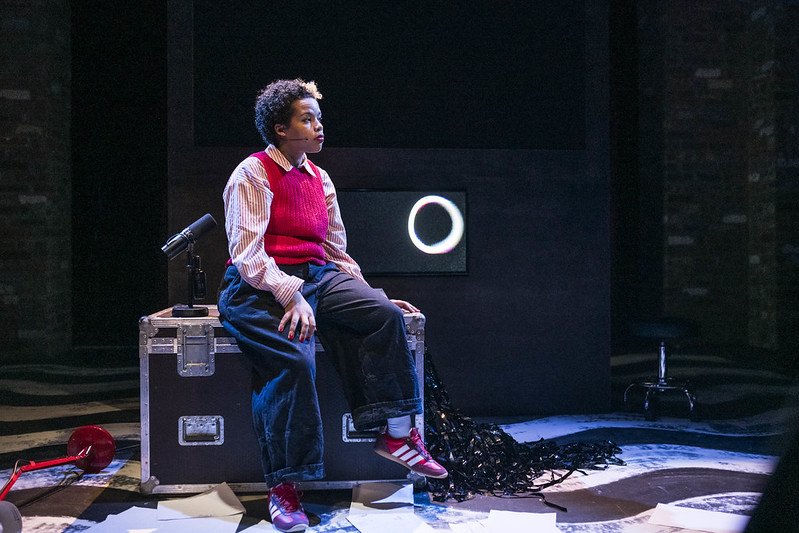
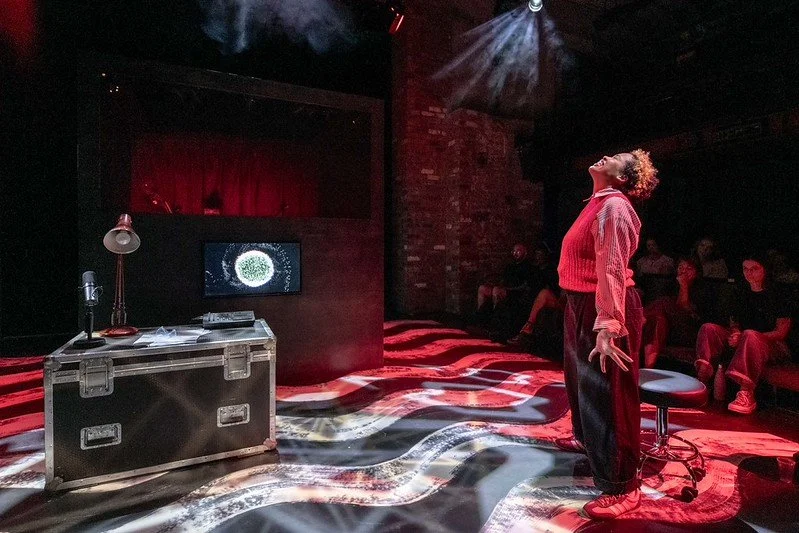
A strange folk song, a disappearance, a podcaster searching for a story and a town where something unsettling has taken root. Badgers, the new play by writer and poet Malaika Kegode, opened at Theatre Royal Plymouth this evening, bringing folklore, live music, true crime, grief and shape-shifting storytelling together in a production with deep roots in the South West. Originally commissioned by Theatre Royal Plymouth and created with music by Kegode’s long-time collaborators Jakabol, the play asks some big questions: why are we so drawn to other people’s stories, who has the right to tell them, and how do we know when it is time to let go? Ahead of its Plymouth run, we spoke to Malaika about creating Badgers, her relationship with the city and why ambitious new theatre made in the South West deserves to travel far beyond it.
For anyone discovering your work for the first time, can you tell us a little about yourself and how you found your way into writing for theatre?
I loved theatre growing up, but in my early twenties felt like perhaps I’d missed my chance by not completing my college education or going to university or drama school. So instead, I worked on theatre box offices and bars, while also writing and performing poetry at open mic nights in Exeter, Totnes and Plymouth. These things allowed me a gateway into the industry, kinda scrambling in through a window that’d been left ajar!
I have always read and watched widely - spoken word, theatre, film, music and comedy - and this continuously forms my education as a writer. I’m a real patchwork of my influences, while also being very dedicated to unique narratives that challenge expectations of rural, working class and dual heritage identities.
My first piece of writing for theatre was the show OUTLIER, it was an autobiographical show that really showcased what had formed me as an artist and person up until that point. It had music (created and performed onstage by my long-time collaborators Jakabol), poetry, theatricality and lots of cultural references.
Since then, I’ve continued to write for theatre, and the work I make always looks to play with form and incorporate mixed-disciplines. Badgers continues this evolution, also incorporating my more recent forays into short story and radio writing.
Where did the first idea for Badgers come from?
Badgers has been through lots of transformation during its gestation, and if I’m not careful this could be a very long winded answer, so I’ll try to keep it brief! The original idea for the play was born through a conversation with Joe Williams (guitarist in Jakabol and Badgers) and Jenny Davies (our director). The idea was about someone going to a Somerset village to record a traditional folk song and being met by animosity from the locals and the land for doing so. The character of an older woman with a connection to this song came into view, and I started doing some research around aging in rural society in sociology and folklore. I discovered some strange parallels between older women and badgers - both often scapegoated and demonised as tricksters, but also seen as wise figures with deep connection to the earth. So these bits of research collided with my interest in the ethical connotations of true crime culture and why we clamour for stories to make sense of our own messy lives and Badgers was born.
3. The show brings together folklore, true crime, grief, music and mystery. How did those different threads begin to connect for you?
I was thinking about how many folk tales and songs we’re familiar with are so dark and slippery. My mum used to sing us lots of folk songs growing up, and the ones that really thrilled me were the murder ballads. This is a whole sub-genre that spins tales of death, crime and mystery. These are stories told through time as warnings, entertainment and grim fascination through oral tradition. It made me think - aren’t these basically a prototype of true crime storytelling and podcasts? Humans have always been drawn to music and stories to make sense of what feels difficult or scary… Death and grief, the passage of time, and the fear that comes with knowing not everyone has good intentions at heart.
Our director Jenny had a brilliant vision to create something that felt like a folk tale with true crime threaded through, allowing traditional folk to sit alongside modern tech as a continuation of storytelling tradition.
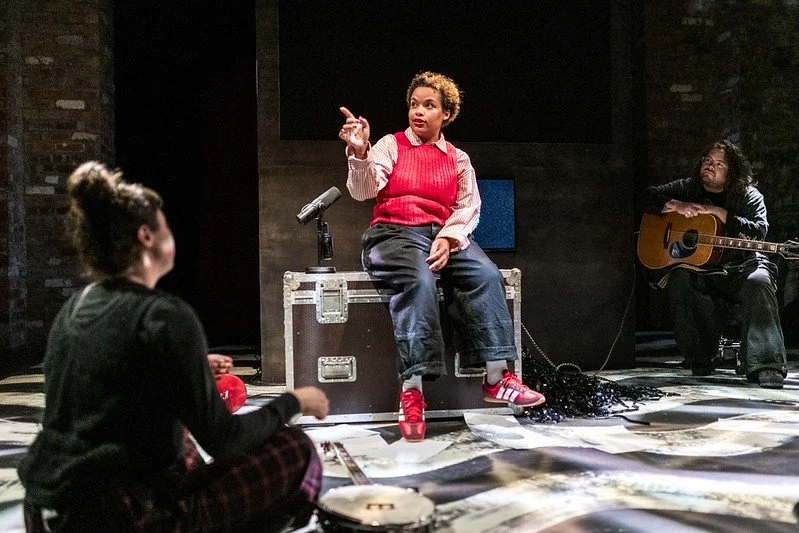
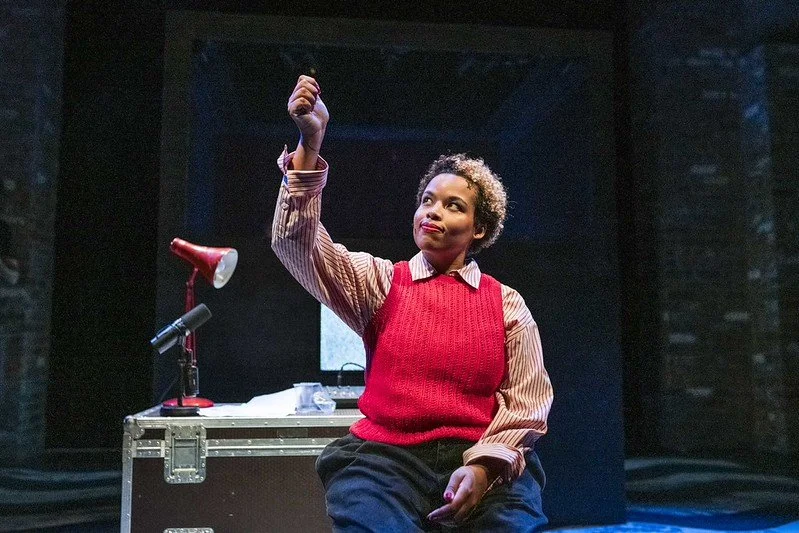
At the centre of the story is Meles, a podcaster whose career is stalling while her mother is dying. What drew you to her as a character?
People sometimes say to me that I always seem very composed and put together. I’m definitely a very internal person. Despite anxiety and self doubt bubbling away in my head a lot of the time, I’m quite good at not letting it show. So I wanted to write a character whose mess is always on show, someone whose insecurity felt palpable and human. It was fun to write a character who is so impulsive, and to invite everyone in to be part of her bad decisions!
She’s very representative of the millennial quarter-life crisis - finding herself in her mid-30s, coming to terms with the fact her life isn’t what she thought it would be and feeling her time is running out. I think we all have a little voice telling us we’re not good enough, telling us to do the bad things, chastising us at every turn. Meles’s voice is loud; she listens and reacts. Sometimes it’s painful and you want to give her a shake, but hopefully you also want to give her a hug and tell her everything will be alright.
One of the big questions in Badgers is around who has the right to tell someone else’s story. Why did you want to explore the ethics of true crime and storytelling?
As someone who is often inspired by people in my life, as well as creating autobiographical work in the past, I am constantly checking in on myself to ensure I am doing so with care and for the right reasons. I think it’s important to really consider the responsibility we have as storytellers to the figures in our stories (both real and fictional), and to those who might consume them. As a society we can be guilty of shrugging off this responsibility in the name of art or acclaim. I was really interested in unpicking the way we justify bad actions or morbid curiosity by storifying it. Not to chastise people who enjoy true crime or make work inspired by real life, but to be really clear eyed about who is taken advantage of when we prioritise the story over the real people in it, and the impact that has on us as the consumers and makers.
Badgers is described as “a folk tale about folk tales”. What does folklore allow you to do as a writer that a more straightforward story might not?
Folklore trusts the audience to bring their own associations and fears to an image, word or symbol. There’s strength in ambiguity, and these stories are so old that we all carry some part of them with us. These forms have been passed mouth to mouth for centuries, so there's something quite freeing in knowing you're just the latest person to bend the shape of it.
That said, there is also lineage and there are rules. It’s not permission just to be weird, as a writer it presents unique challenges in how you build a world that feels part of a timeless canon. You can’t just turn someone into a tree for the vibes, you need to dive into what that has meant in different places and times to then establish what that means right now for your character and story. It’s a fun place to play with the force of imagery, magic and feeling, while still building a strong internal logic for people to latch onto.
Music is a big part of the production, with Jakabol involved in the show. How did the music and writing develop alongside each other?
I’ve worked with Jakabol since 2018 on various projects, and this gave us a new way of working. Much of the score was composed by Jakabol in response to the script (and a voice recording I sent to them), establishing themes and sound worlds for different characters and moments.This gave us a library of sound to take into rehearsals, where the live score was adapted and built on, with additional compositions created in the room by Bethany Roberts and Joe Williams under the guidance of our music supervisor Harry Miller.
I’ve also asked Joe Williams (composer, part of Jakabol and on-stage musician in Badgers) to answer this question from the music side:
“When it came time to compose the music for Badgers it became clear to me that the most interesting sonic tension would come from the interaction between trad folk and the combined folk revivals of the 60s and the 2010s. Electric mandocello used to conjure a feeling of something primal and ancient. Banjo, more often associated with Americana and revivalism, soaked in digital delay and used to invoke the telling of an impossibly old story.
“Furthermore the human voice is so heavily manipulated in many different ways in the show that I found it paramount that we built as many of the soundscapes and loops with our voices as possible. Pitching them down and distorting them both added an unsettling quality and allowed us to musically communicate this idea of outside corruption of the truth”
Badgers was originally commissioned by Theatre Royal Plymouth. How important has Plymouth and TRP been in the development of the work?
I have a long history with the city, and I always love to come back to Plymouth. Much of my family lives here and I spent my teens bopping about its streets. I also worked at TRP as a Box Office Assistant in my later teens, then returned as an Associate Director (2023 - 2025). It feels nice to be back again in a different guise, creating a story that has its roots in the South West - finding new ways to represent this part of the country which I know so well and whose wealth of stories I feel are often overlooked.
How significant is it for you that ambitious new theatre can be created here in Plymouth and the South West, then travel to places like Edinburgh and reach national audiences?
Hugely significant. There's still a lingering assumption in this industry that ambitious,
formally inventive work gets made in London and then, if we're lucky, touring venues elsewhere get a version of it. Plymouth has always been a place of constant innovation and determination, we don’t stay in our lane and neither should we be expected to. There are great things being made in the regions, and that work deserves to be seen on national stages.I scrambled into this industry through open mic nights in Exeter, Totnes and Plymouth, so being able to make a show here that then holds its own next to work from anywhere else in the country isn't just nice for me personally - it feels important for anyone else in this region wondering if their stories are “allowed” to travel that far.
Do you feel Plymouth or the wider South West has influenced your work and the kinds of stories you are drawn to tell?
Yes, absolutely. I return to Devon and Plymouth as bases for many of my stories because I think people outside of the countryside have specific ideas about what these places are like, and those ideas are often outdated. I’m passionate about really creating diverse stories that disrupt common narratives about rural people and their lives. This isn’t to erase the history of these places, or the shoulder we stand on, but to continue the journey and let the world know who we are now.
The script is also being published by Nick Hern Books. What does it mean to see Badgers have a life beyond the stage as a published play?
It’s really meaningful to me to have this book published by Nick Hern Books. It’s a bit of a dream come true for me, as I’ve grown and held onto my NHB collection for many years, so to be welcomed into their cohort of writers feels incredible. Having this story specifically in print means that even after our run the characters live on, and there’s a huge thematic link there to the story, which is so much about what and how we preserve things and when to let go. I love these characters, and having them in text means that other people get to keep them in their hearts and homes too.
Beneath all the mystery, the show is also about grief and the art of letting go. What do you hope audiences connect with emotionally?
Ultimately, for all its folky reckonings and shape-shifting form, the show is about what we do to find connection when the world around us changes. It’s a celebration of what the act of creation can give us, and an acknowledgement that it can be hard to know when to let go and when to hold on, but that stories can help us do both.
Finally, what do you hope Plymouth audiences are still thinking or talking about when they leave the theatre?
I hope people call their mums - or whoever occupies that place in their minds. I hope they think about the ways they can create art in response to what is happening in their lives in ways that feel true to the feeling, and not consumed by a need for approval or admiration.
Much of my work celebrates how our lives are made up of all these little mundane moments,which magically compound into the most significant parts of who we are. I hope it allows audiences to find these moments, hold on to them for a while, then - when they’re ready - let them go so they are ready for the next moment. And the next. And the next.
