
The human has to stay at the centre: In Conversation with Alex Alani on music, quantum computing and the future of creativity
What happens when the person experimenting with the music technology of the future is also one of the people questioning where technology should stop? Ahead of LifeIn AI at Plymouth’s Market Hall, Bracken Jelier spoke to musician and researcher Alex Alani about quantum computers, artistic integrity, the backlash against AI and why, whatever comes next, creativity still needs humans at its heart.
There is something wonderfully contradictory about Alex Alani.
He is a musician who has spent most of his life immersed in instruments, live performance and the very human business of making music with other people. He plays oboe and trumpet, raps, teaches, performs across Plymouth’s grassroots music scene and has even recently added jazz oboe to the list.
At the same time, he is completing a PhD at the University of Plymouth exploring quantum computer music; using technology most of us struggle to comprehend to investigate sounds and production techniques that have never existed before.
And while that might place him firmly on the side of our increasingly technological future, Alex is surprisingly clear about one thing: technology should not replace artists.
“I don’t think AI should be used to generate music,” he says. “I don’t think it should be used to generate your band posters. I don’t think it should be used to create any sort of visual art or literature or anything to replace anything creative.”
It is perhaps exactly this tension that makes Alex such an interesting person to speak to ahead of LifeIn AI 2026, taking place at Market Hall in Devonport on Wednesday 23 September.
Because beneath the conversations about artificial intelligence, quantum computing and the music technology of tomorrow is a much older question: what is it that makes creativity human?
From classical oboe to quantum computers
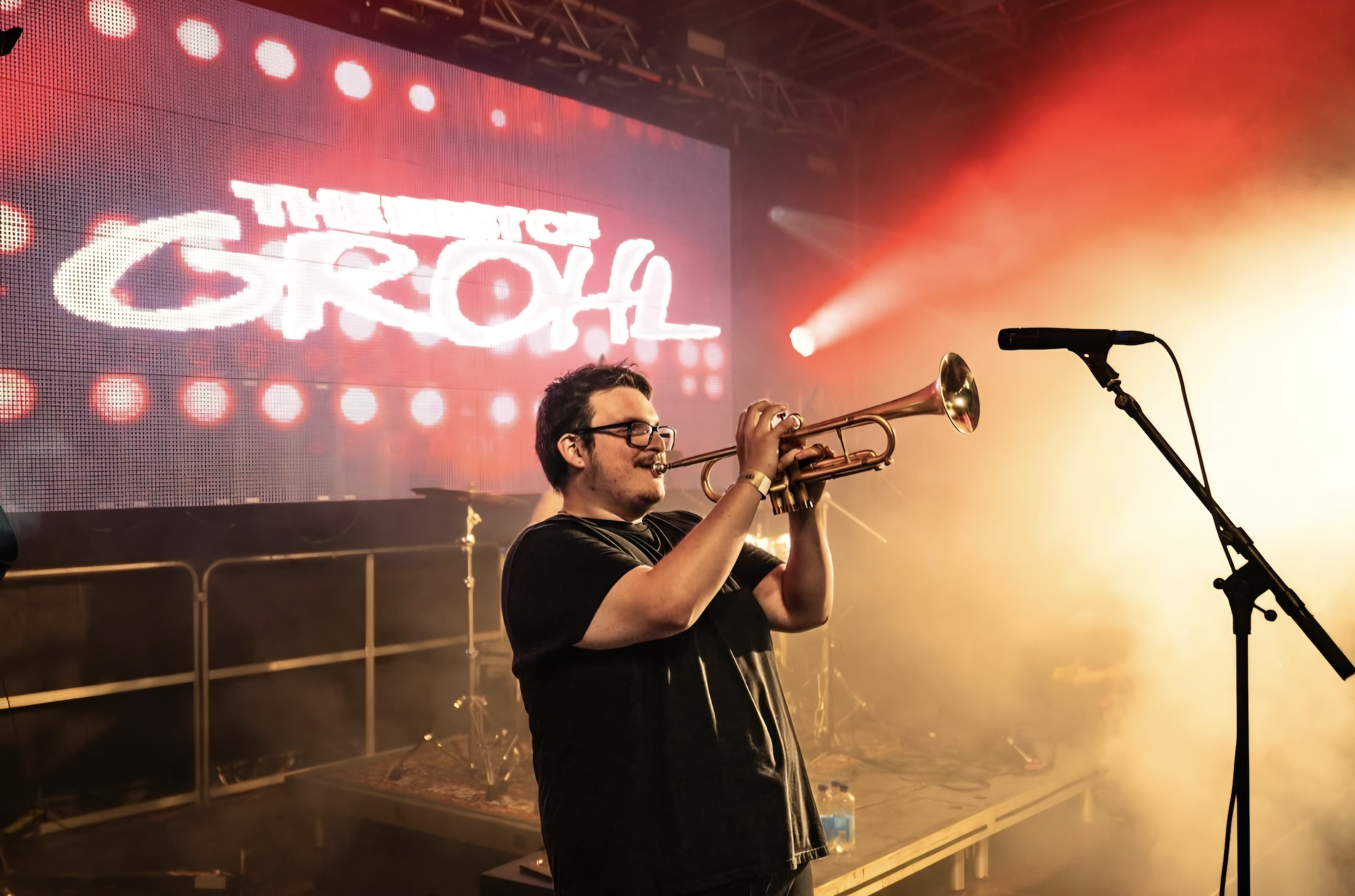
Alex playing trumpet with The Best of Grohl at Alstock 2026 in July in Bodmin
Alex’s route into this world certainly wasn’t obvious.
He started playing the oboe aged eight, followed by trumpet at around 13, growing up surrounded by classical music and jazz before studying oboe performance at Indiana University’s Jacobs School of Music.
Alongside classical music, however, came soul, funk and hip-hop. “I used to think, ‘Well, I’m only good at oboe. I’m only good at trumpet. This is all I can do,’” he explains.
Music technology changed that. While studying in the US, Alex discovered Professor Eduardo Miranda’s work in quantum computer music. What began as curiosity developed into research, including time at Argonne National Laboratory in the United States, which eventually brought Alex across the Atlantic to Plymouth.
Today he is completing his PhD within the University of Plymouth’s Interdisciplinary Centre for Computer Music Research (ICCMR), working alongside physicists, mathematicians and computer scientists while bringing something rather different to the room: the perspective of a working musician.
“I’m often working with physicists and computer scientists and mathematicians that might not necessarily understand the perspectives of a music producer or a composer or a live working musician,” he says.
“My life and work is trying to bridge that gap.”
Perhaps most remarkably, Alex says science was never something he imagined pursuing. “I was bad at STEM. I failed physics in high school,” he laughs. “I was just like, ‘I’m the music guy. That’s other people that are smarter, they do that.’
“Then once I got obsessed with it, I never took it seriously as a career. It was just, ‘This stuff’s cool and I like talking about it with my friends.’”
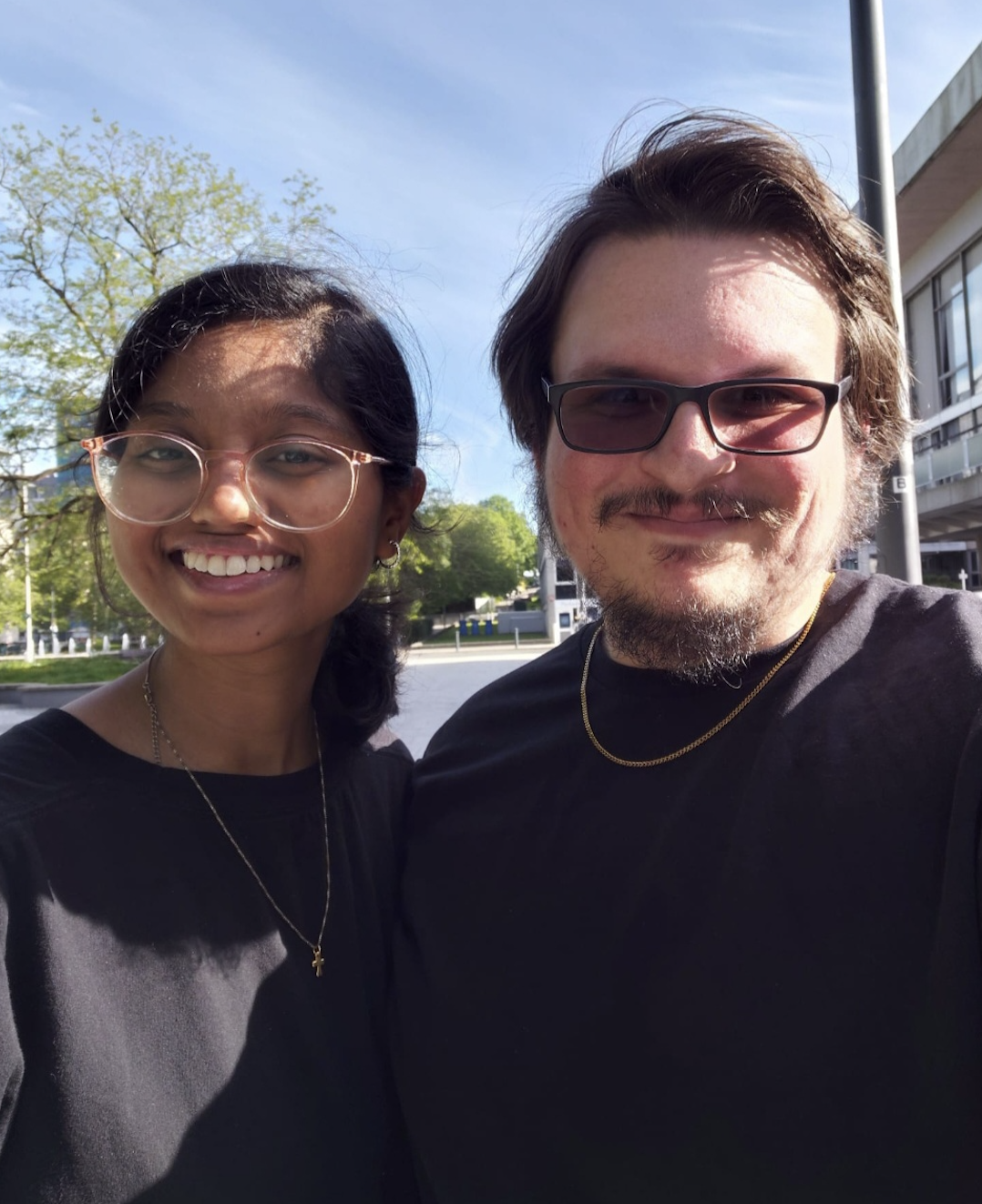
Alex and his wife Vanisha met as the only two international students in the University of Plymouth Big Band
So what does quantum computer music actually sound like?
It is the obvious question. If you were sitting next to Alex in a studio, what could a quantum computer allow him to do that conventional music technology cannot?
One of his experiments involves something he calls a simulated quantum gate distortion.
Alex can take a recording of himself playing trumpet, map that audio onto a simulated quantum circuit, manipulate it and then listen to what happens to the sound. His recently published research explores an even stranger possibility.
Traditional audio effects such as a bitcrusher deliberately destroy information in order to create their characteristic distorted sound. Once that information has disappeared, it cannot normally be recovered.
Alex has been experimenting with a method that allows that process to be reversed. “I could send you a crushed audio file and then you could send it back to me a year later and I could use the reverse kind of circuit in a quantum computer and you could hear basically exactly the original again.”
A short YouTube demonstration unexpectedly received around 9,000 views and even connected Alex with another physicist overseas who may now become a future collaborator. But for Alex, the most important part of the research isn't simply proving that the technology works. It is asking whether it can give musicians something genuinely new.
Creating something new, not replacing what already exists
That distinction becomes particularly important when the conversation turns to AI.
Much of the cultural backlash against generative AI has focused on music, writing, imagery and other creative work being generated using systems trained on enormous amounts of existing human creativity.
Alex sees quantum computer music very differently. Rather than asking a machine to imitate something humans already make, he wants to create new tools for humans to use.
“I think giving music producers more tools is important,” he says. His concern is what happens if technology instead becomes a shortcut around employing or collaborating with artists. “The biggest fear is, ‘Okay, well this stuff's getting really good.’
“I really just want live music to continue.”
It is why his own musicianship remains inseparable from his research.
Rather than reaching for anonymous audio samples to demonstrate a piece of technology, Alex records himself. Trumpet. Oboe. Vocals. Keys. Whatever the project requires.
“When you actually have a professional musician creating a sample that is used to demonstrate something technologically, it has so much more substance.”
For him, the musician does not disappear behind the technology. The musician is the point.
The uncomfortable conversation around AI
It is impossible, however, to talk about artificial intelligence and culture without acknowledging the considerable anger surrounding it.
Artists are asking questions about copyright, consent and whether their work has been used to train generative systems. There are environmental concerns surrounding the energy and water requirements of large-scale computing. And beneath it all sits an understandable fear about livelihoods.
Alex doesn't dismiss those concerns. Far from it. “I feel how they do,” he says.
But he also believes that simply dividing the world into people who are either “for” or “against” AI makes a complicated subject almost impossible to discuss.
Even describing his appearance at LifeIn AI has required care.
When somebody proposed calling him an “AI-assisted music performer”, Alex immediately pushed back. “No, no, no. We have to word it differently because it’s not AI music.”
That nuance matters. For Alex, using technology to help solve a coding problem is fundamentally different from asking it to generate the creative work itself.
“I'm the musician and it should be a supplemental tool.”
And when it comes to AI's environmental impact, Alex would like to see the conversation move towards practical solutions too; particularly around the design and operation of the data centres underpinning the technology. Rather than pretending those environmental consequences do not exist, he argues that research and engineering should be directed towards tackling them. It is, he admits, a difficult conversation to compress into the binary world of social media.
“This nuanced kind of talk we're having, it would be hard to put in an Instagram story.” Perhaps that is precisely why longer conversations like this matter. Because somewhere between unquestioning enthusiasm for new technology and rejecting it altogether lies a much more interesting question:
How do we decide what we actually want technology to do for us?
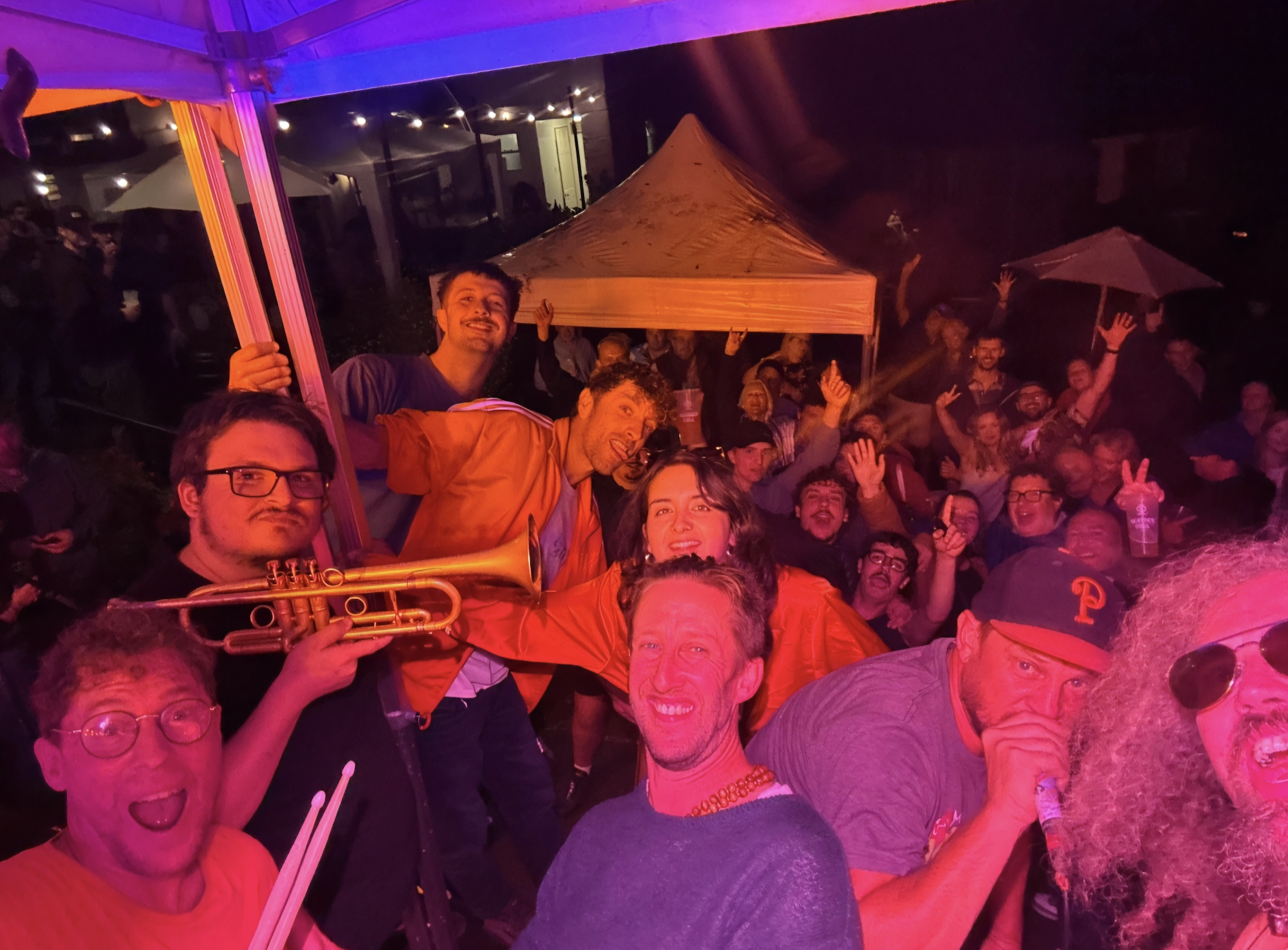
Alex at the Freshly Squeezed show in Metherell at The Carpenter Arms in August 2026
Spend any time talking to Alex and the technology quickly gives way to music. He performs with Cornwall-based funk and hip-hop band Freshly Squeezed, where alongside trumpet duties he has unexpectedly acquired another role.
Rapper.
Or, as Alex puts it, “assistant second-chair rapper”. After quietly revealing some bars he had written during a festival performance, his bandmates added the verse to the end of their live set. Now, unsuspecting audiences watch the trumpet player suddenly get handed a microphone.
“The crowd just goes insane,” he laughs. “They never see it coming.” He also teaches through Plymouth Youth Music Service, something he says he loves even more than gigging and regularly appears alongside musicians across Plymouth.
Far from competing with his research, all of these different musical lives feed it. Classical music, jazz, funk, hip-hop, improvisation, teaching, technology and performance become part of the same creative ecosystem. “All of that can be used as samples in my research,” Alex explains.
Technology might manipulate them. A quantum computer might transform them. But they begin with a human being making music.
Why Plymouth?
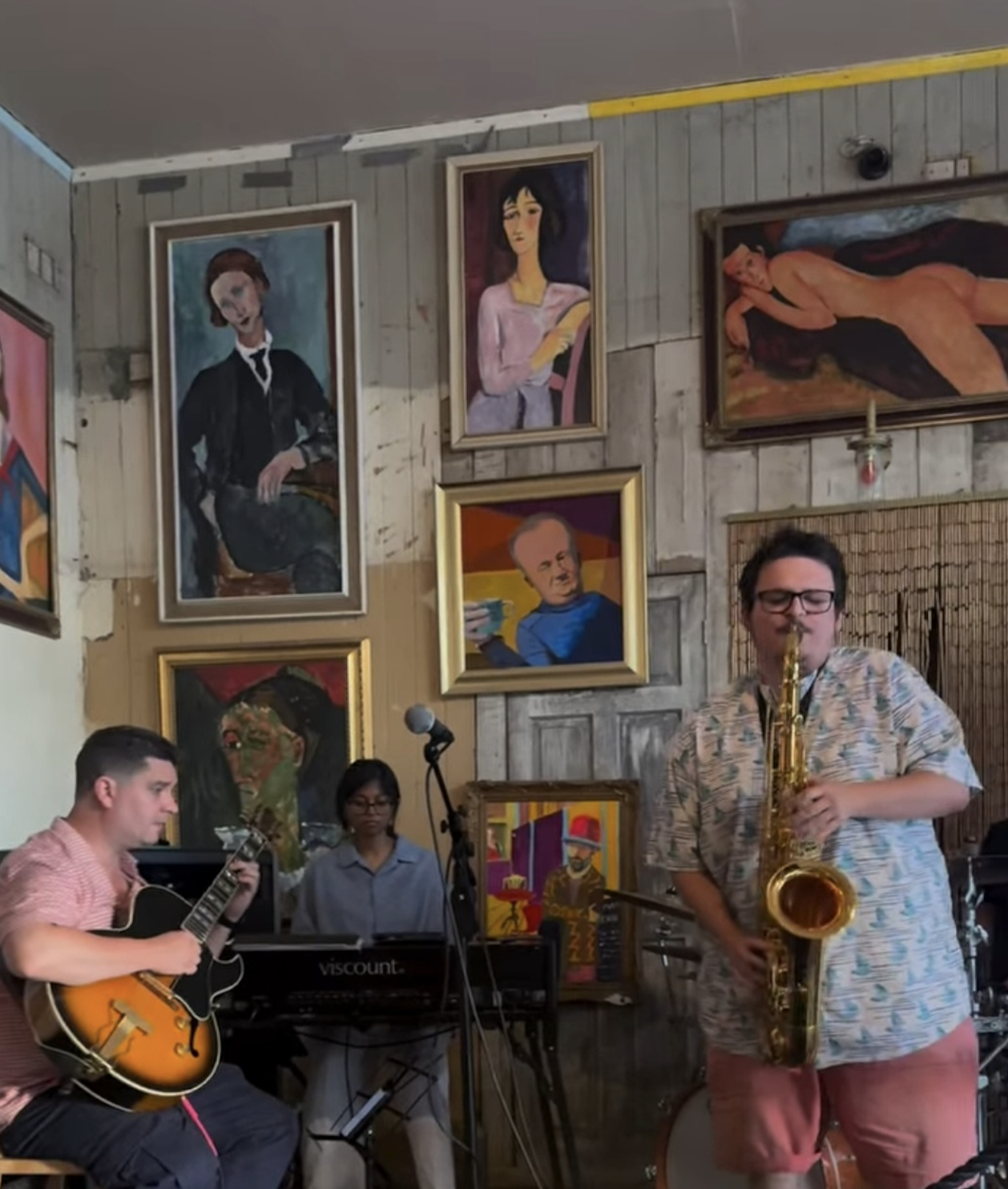
Alex playing tenor sax at Neil Burn's Sunday Sermon Jam Session.
Alex moved to Plymouth specifically to undertake his PhD and work with Professor Eduardo Miranda, but the city itself has become another unexpected part of the story. “I think there have been a lot of surprises being in Plymouth,” he says. “One is that there's a solid music scene here.”
On his very first night in the city in September 2024, Alex headed to the Blues Bar and Grill and found himself playing with Plymouth musician Vince Lee. He has been embedding himself in the city's music community ever since. Alongside that grassroots scene, he sees another Plymouth: one where science, arts and technology increasingly overlap.
At ICCMR, researchers are asking questions about the future of music. Elsewhere across the city internationally recognised research is happening in marine science and environmental research.
For a city that Alex thinks can sometimes be dismissed by those who don't know it, there is a lot happening below the surface. “The more you learn about it,” he says, “and when you learn about the research they do with microplastics and marine biology and the kind of work I'm doing at ICCMR and how many people come from all over the world… I think it's trending in a good direction. I think it's a special place.”
Bringing quantum music into the Dome
At LifeIn AI, Alex will take that research out of the laboratory and into Market Hall's immersive Dome. His 30-minute session will be split between conversation and performance. First, he will explain his research, the infancy of quantum computer music and some of the uncomfortable questions around AI, creativity and keeping technology human-centred.
Then comes the music. Alex has written two compositions for the event.
The Teacher is based on Horace Silver's jazz standard The Preacher, with Alex recording bass and keys before applying his experimental distortion processes.
The second, Cremyll Ferry, is a piece Alex wrote around a year ago featuring vocals, keys and his own technological experimentation.
For the Dome performance, it will be accompanied by underwater imagery and jellyfish moving across the immersive screens while Alex performs live trumpet using a wireless microphone. No slides. No conventional lecture. Just a musician walking through an immersive digital environment, talking about research and then demonstrating what it can become.
Which somehow feels like a fitting conclusion to the conversation. Because perhaps the future of culture isn't a choice between humans or technology.
Perhaps the more useful question is what happens when artists are the ones deciding how that technology gets used.
And Alex Alani is very clear about where he believes it should begin.
With the artist.
Find out more about Alex Alani
You can follow Alex’s work, research and performances on Instagram at www.instgram.com/alexalani.qcm
He is also a regular face on Plymouth’s live music scene, including the Sunday Sermon Jam at Café Momus and Russell Sinclair’s Wednesday night blues jam at Piermasters, as well as performing with bands and musicians including Freshly Squeezed and Urban Party Project.
