
From colourful underpasses and community spaces to schools, hospitals and one of Plymouth’s newest lighthouse sculptures, the work of Mrs Murals is becoming an increasingly familiar sight across the city.
Inspired by nature, passionate about the environment and driven by a desire to create art that makes people feel good, her journey to becoming a professional mural artist began not with a carefully mapped-out career plan, but during an unexpectedly difficult period of her life.
“I began life as Mrs. Murals during a bit of a difficult time. It was 2020 when I started making a living from it. I had a two-year-old and a one-year-old and I'd just been made redundant. The insurance company that I worked for closed their offices in Plymouth, so I was without a job and I struggled to find work. I could only work part-time because I needed to look after my boys. But then if I worked part-time, the only thing I could find was minimum wage and it wouldn't justify the cost of sending my boys to childcare. Essentially, I couldn't afford the cost of childcare, so I set up my own business.”
She considered photography before deciding to follow something she had always loved: painting.
“I've always loved painting on my own walls. It's always been a bit of a passion of mine. I've always thought, why would you want to keep to a frame when you can have the whole wall?”
She began by transforming the walls of her own home, building a portfolio as she went. But the timing also influenced the kind of artist she wanted to become.
“It was during the pandemic, so I was really keen to try and create some uplifting art for the community. I painted on my own house outdoors to create some colourful light, bright, positive artwork that would lift spirits for people. I guess it started from there.”
Nature quickly became one of the defining influences on her work – not only visually, but in the way she runs her business.
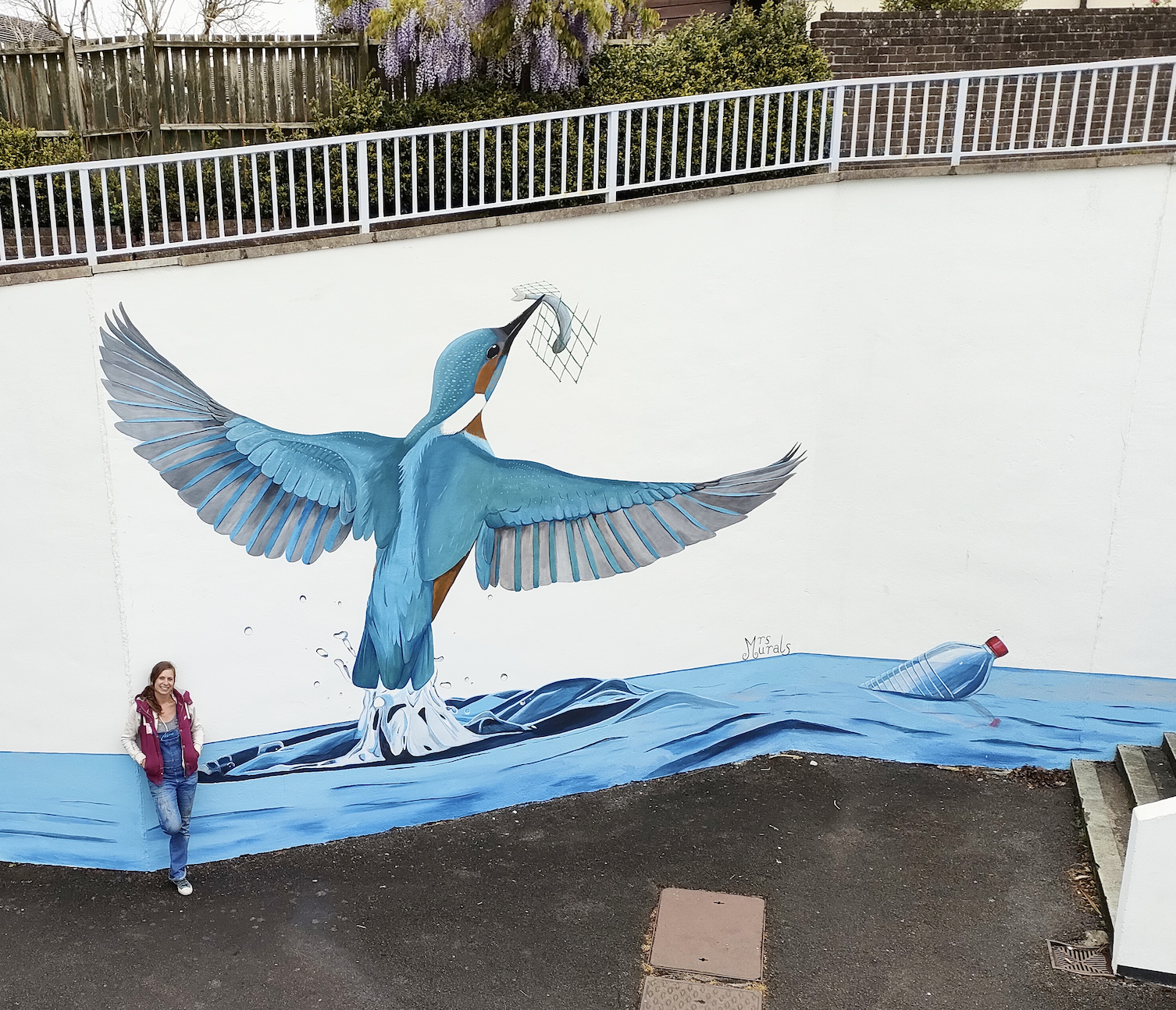
Kingfisher subway in Plympton
“My work is very inspired by nature and the environment. I've always tried to create positive, bright, uplifting artworks. I'm very passionate about the environment, so I'm very inspired by nature, which inspires the type of work that I do. But I'm very conscious of trying to protect it and be as eco-friendly and sustainable within my business as possible, so I use non-toxic water-based paints and brushes for all my artwork. I try to reduce, reuse, recycle as much as possible within my work and promote the importance of protecting nature and the environment wherever I can as well.”
One of her earliest commissions was deeply personal: a wildflower mural created for a local family in memory of their son, who had been cared for by Children’s Hospice South West.
“It was a lovely project and they usually have me back every year to add a flower. They're such a lovely family. I'm still in touch with them.”
From those early private commissions, her work began to grow.
“It started with local private work both indoors and outdoors and people's houses, and then it sort of snowballed to much bigger community projects and public artworks. I was commissioned to do artwork at schools, libraries and large public spaces like the underpasses and now going into hospitals, which is very exciting.”
Community has remained central to what she does.
“I love working with the communities, with local businesses, helping to spread awareness using my social media of local businesses wherever possible, but also charities as well. Wherever possible, I'll help to raise funds and awareness of local charities wherever I can through my work. And that's something I'm quite passionate about.”
From blank wall to finished artwork
Every mural begins by understanding the space itself.
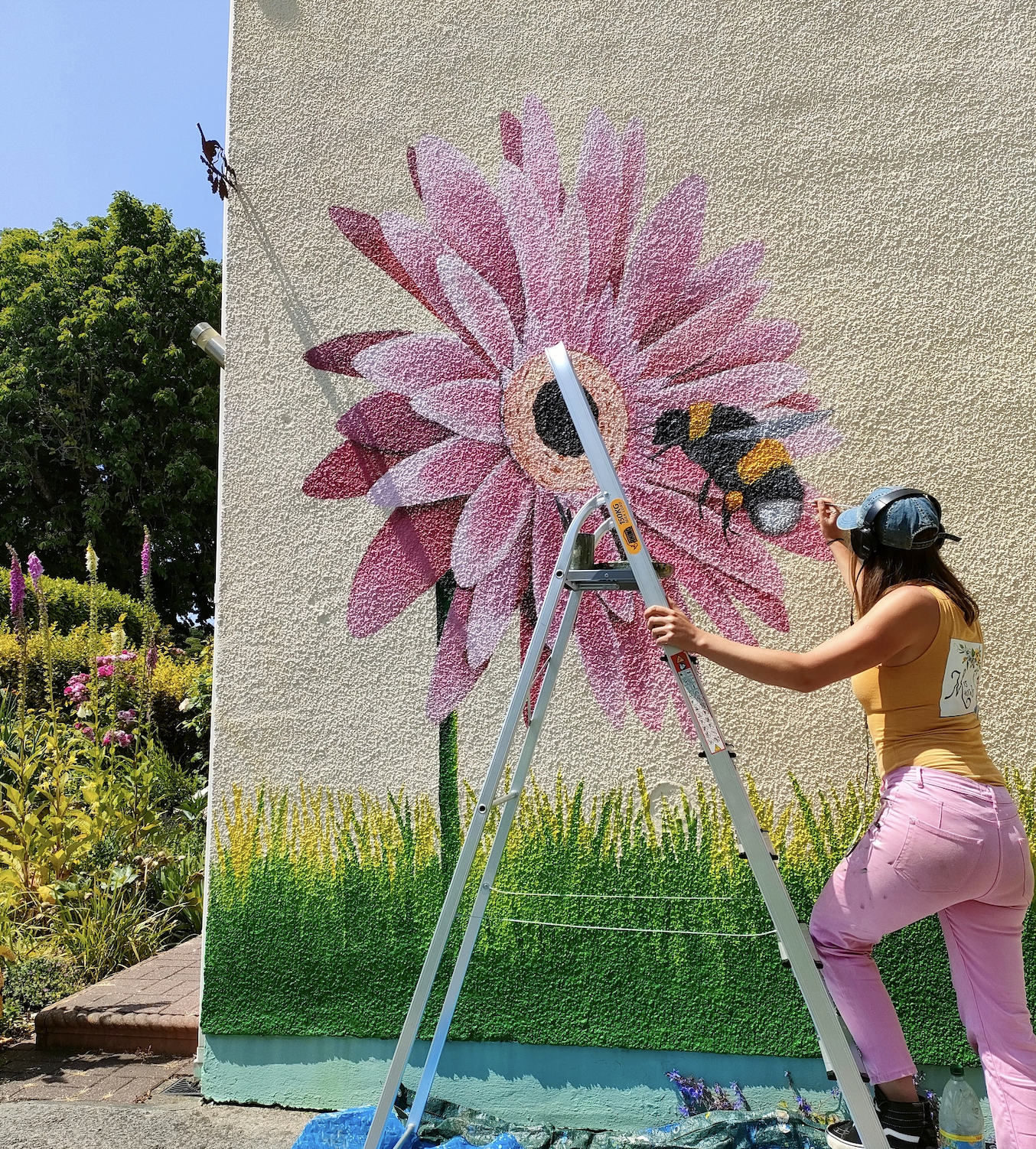
“Normally what I ask is I ask a customer to send me a picture of their wall, whether it's indoors or outdoors, because that'll give me an idea of a scale. It'll give me idea of the texture of the wall, the height, the size, and all the other stuff, and the sort of architecture of the wall so I can see what will fit within that space and how it will work.”
Rather than simply placing an image onto a surface, she considers how a design will become part of its surroundings.
“I like creating the design that will compliment the architecture of the wall, but also complement the colours around it. I like to try and colour match as well whenever possible.”
Designs are created using Photoshop before being shown to the client.
“I'm not one for AI. I'm quite traditional in the way that I work.”
An average indoor mural might take around three days, while larger public commissions can involve weeks of work. One particularly ambitious project will see her tackling an entire building.
“In August I've got the whole of a building on the outside that I'm painting and that's taking three weeks.”
The building is Quaker House on Mutley Plain, bringing another substantial piece of public-facing artwork into the heart of Plymouth.
Although commissions are carefully planned, there is still room for moments of spontaneity.
She recently experienced that while working within an NHS setting.
“Some of the staff walked past me because they work in the ECG corridor and they said, ‘Oh, it'd be really good if we just had a little heart in there.’ So I added a little heart in there.
“It's just little things. If there's small changes that I think, oh, actually this would look really cool, then I'll speak to them obviously first, speak to whoever commissioned me and make sure they're happy and then they'll add or amend or take away.”
Those conversations are also one of the pleasures of creating art in public.
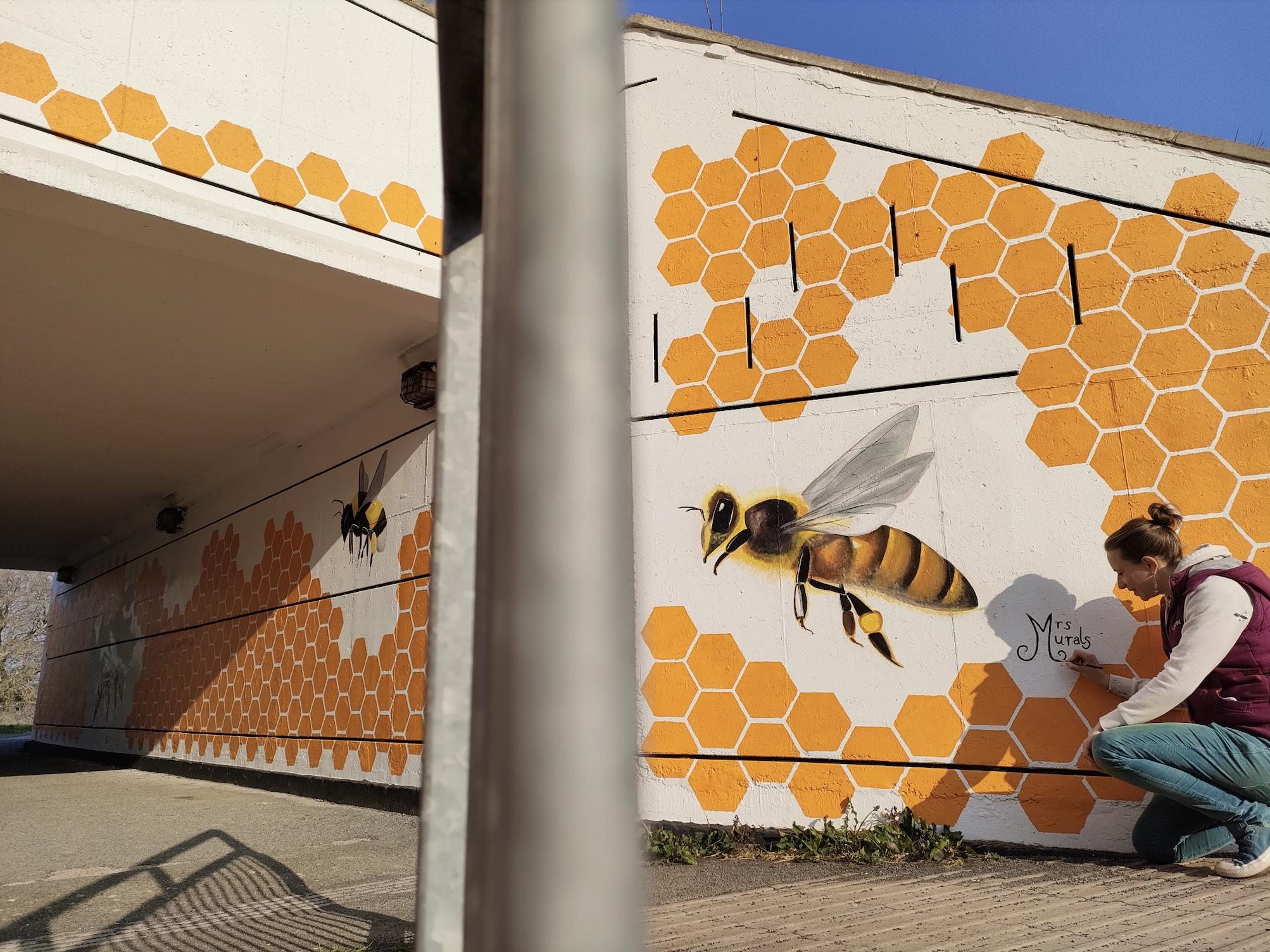
The Bee subway in Plympton
“The great part of my job is being able to meet so many different members of the community or different kinds of businesses and just getting to know so many different people all over the place. I'm very lucky in that sense.”
Often, passers-by initially have no idea what is taking shape.
“Sometimes people will see me working. They don't really understand what I'm doing because it's only just little splatter on the wall, you can't really see the process or understand what's happening and they're a bit confused. Then when the design starts to develop that's when people start coming over to me talking to me about it and they're like, ‘Oh wow, this looks great. What's this for?’ When it's a public artwork, it's nice. And then I'll get to explain, ‘Oh, this is what it's for and we're raising money for, or we're raising awareness for,’ or whatever.”
Creating ownership through public art
One of the most interesting effects of public murals, she has found, is the way communities begin to take ownership of them.
Large blank walls can often attract tagging, but a piece of artwork that local people connect with can change how a space is treated.
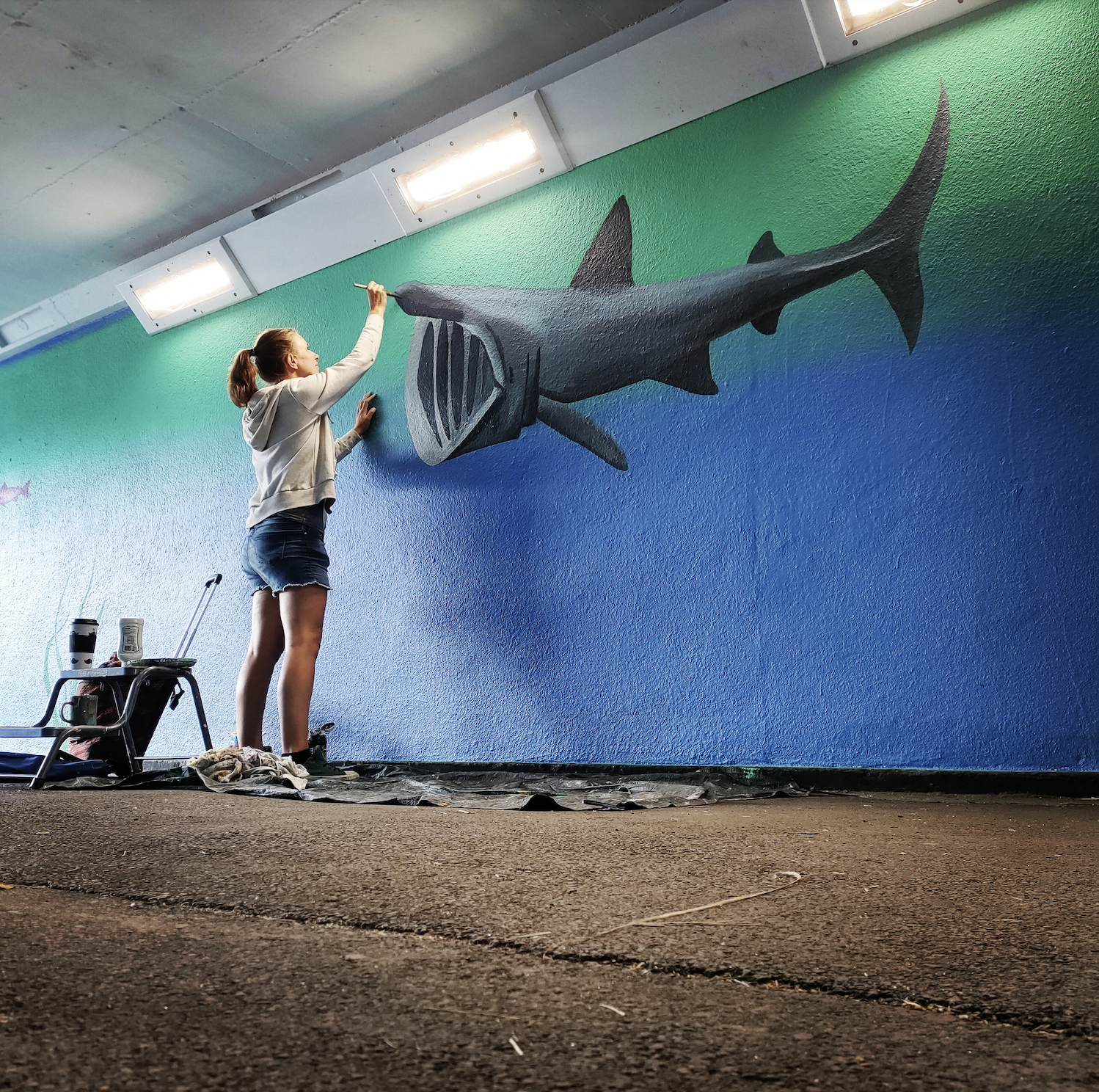
The underwater subway in Plympton
“If you've got a nice well-done mural in place in a public place, it tends to not attract as much tagging and unauthorised graffiti because taggers usually want their tag to be seen, if that makes sense. And if people enjoy the artwork and they like it, they tend to respect it.”
At the underpasses she has painted in Chaddlewood, that connection has gone even further.
“The public, the local community there love the artwork so much that they help protect it themselves. So they go out with their own paints, their own brushes, and if they see anything, they'll touch it up straight away. So I'm really lucky in that sense.”
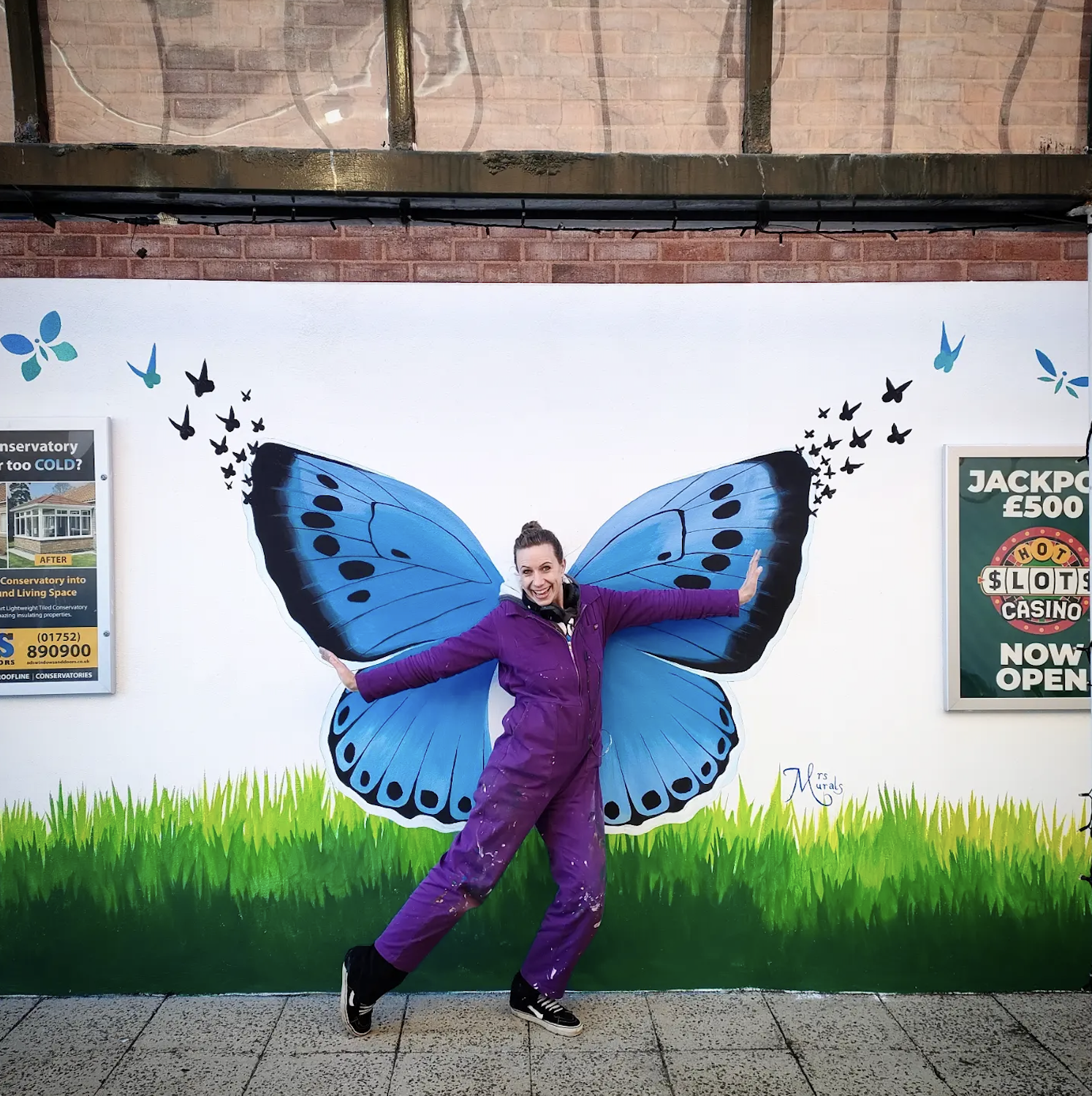
Butterfly Wings at Plymstock Broadway
At Plymstock Broadway, she transformed the tunnel linking the car park and shopping centre, including a set of large butterfly wings that have become a favourite spot for photographs.
“Lots of people, they always say to me, ‘Oh, it won't last long. Oh, it won't be long till that's all written over.’ But that's one of the places that I don't think has ever had any kind of tagging or scratches or anything. But people love it. People still tag me in their pictures of what they take there because there's some big butterfly wings.”
For Mrs Murals, involving communities directly can make that sense of ownership even stronger.
“We did a youth engagement session where we brought young people over to add to all of that. They helped to add lots of different things onto the subways, creating their own artwork, but it helped to create a sense of ownership as well in the area. I think the more people enjoy it and like it, the more they tend to protect it and respect it.”
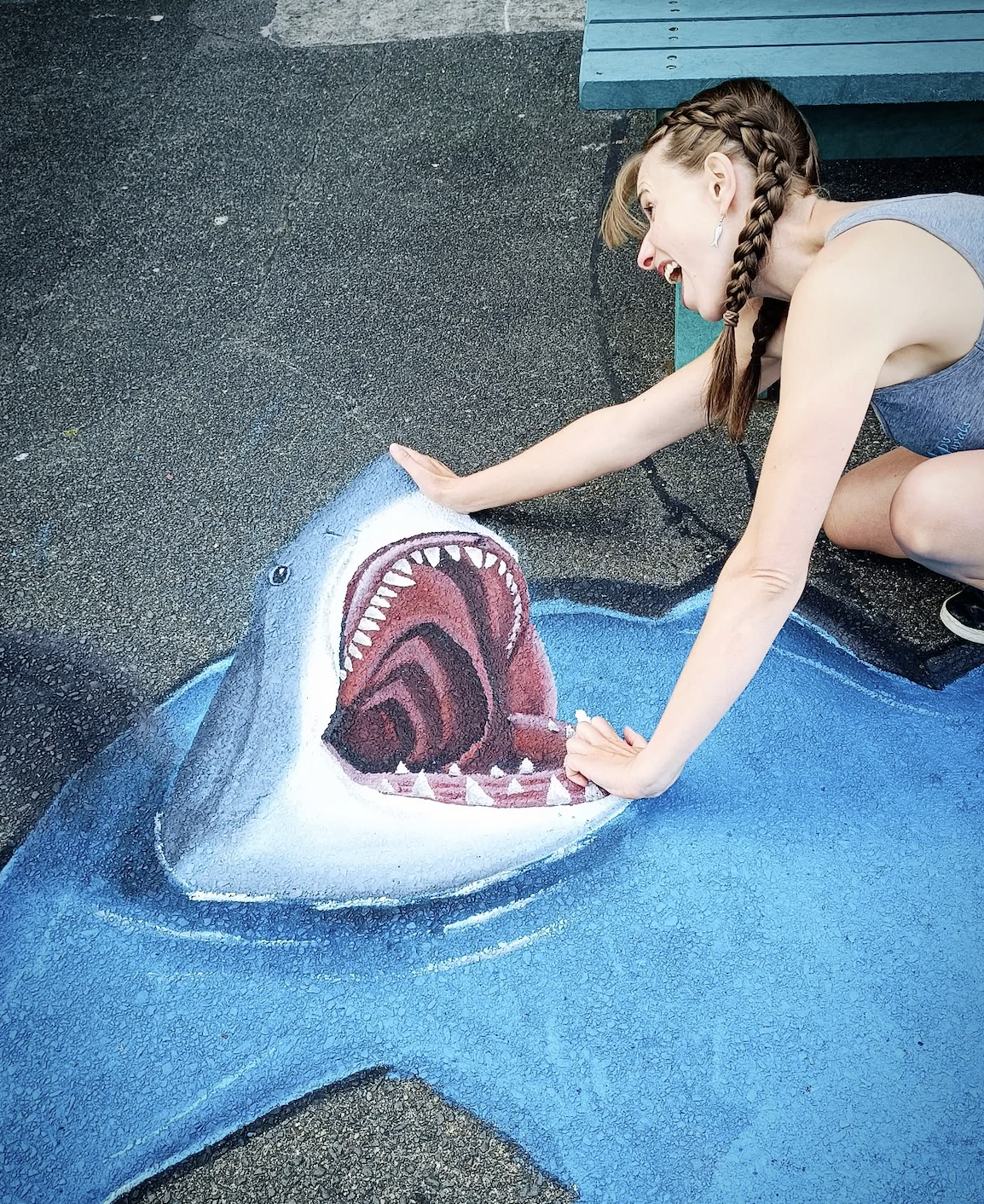
Interactive pavement mural in Mutley 2026
Inspired by Plymouth
Plymouth itself provides an almost endless source of inspiration.
“I'm very inspired by the natural world and we're very lucky in Plymouth to have so much on our doorstep. I mean, we've got the moors nearby, we've got the beaches, we've got the underwater, incredible biodiversity here, which inspired the artwork that I did on the lighthouse and lots of amazing local businesses.”
That relationship with the city is something she wants to be reciprocal.
“I'm really lucky to live in a place where I have so much inspiration to work from, but also so many lovely local communities and businesses to work with. And I'm really grateful for that. I try and give back to the community as much as I'm getting because I owe a lot to the local community.”
That support has also helped sustain her through the realities of trying to make a living as an artist.
“Especially during the winter I do find it can be challenging. There are lots of ups and downs and I guess being passionate, being persistent and having this drive and ambition has really helped me. Belief as well, just belief in my own capabilities and what I can do and not underselling myself.”
Like many artists, she regularly encounters the expectation that creative work should be provided free in return for “exposure”.
“As an artist, we quite often get asked to do a lot of things for free for exposure. And I'm sure most artists can relate to that. You wouldn't ask any other kind of service provider to work for free. It does confuse me why a lot of people think that artists should work for free just for the exposure.”
Balancing work with raising her children has made valuing her time particularly important.
“I've got absolutely no support network, no family network nearby, so I've always had to rely on paying for childcare.”
Persistence, however, does not mean an absence of doubt.
Asked whether she experiences creative blocks or self-doubt, her answer is immediate:
“Every day.”
“I mean I think most artists do. There's always challenges, always difficult times. Creative blocks are a regular thing and you just got to take yourself away, give yourself time and then come back to it. It's just a way of life. I always think I'm a perfectionist at heart, which is a good thing, but it also can be detrimental because I'm always really criticizing myself and thinking that could have been better. I should have done that.
“But then it's just something you learn from and then you take it on to the next job, don't you?”
Guiding Lights and a very special lighthouse
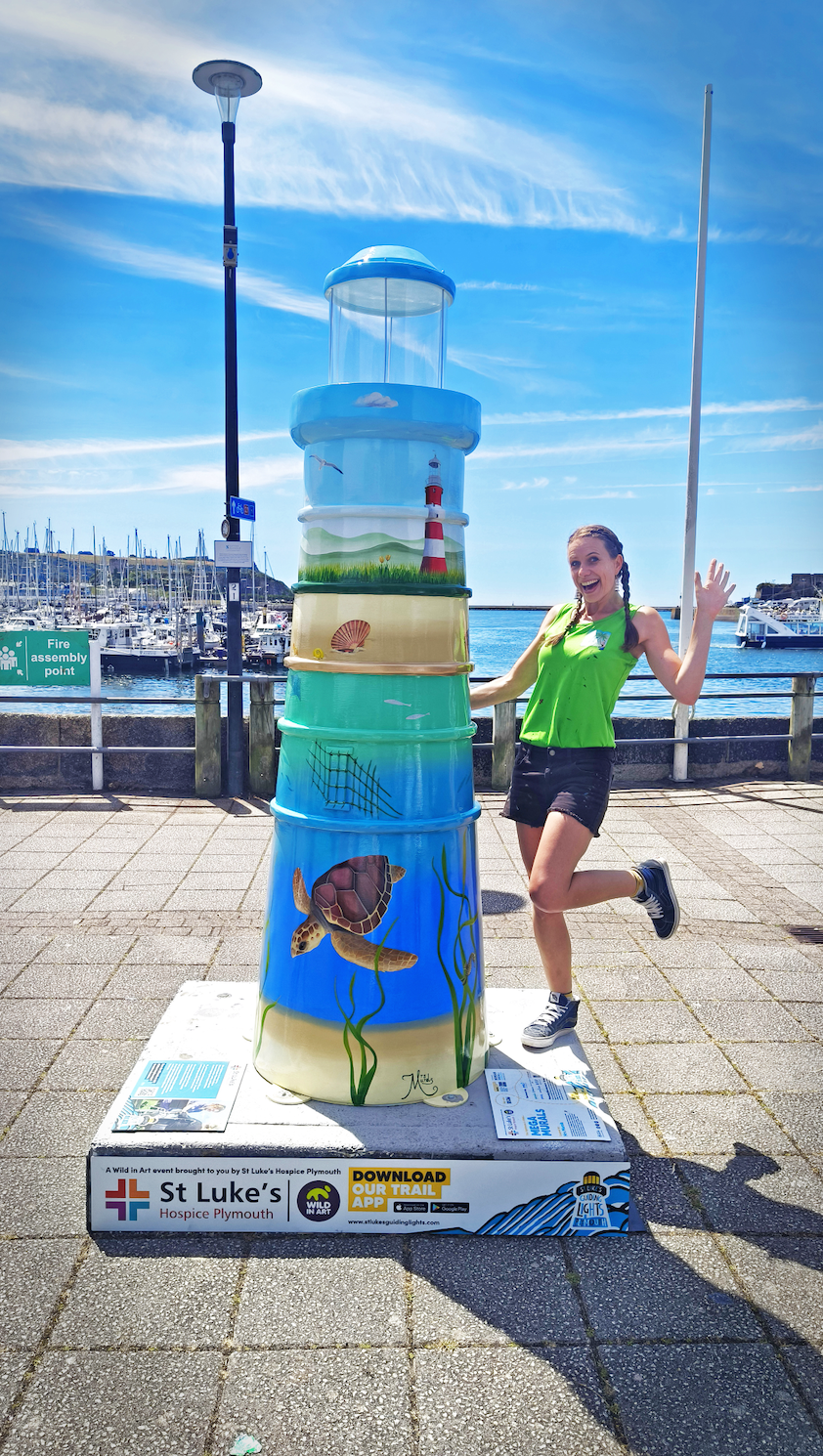
One of her most visible recent pieces forms part of St Luke’s Hospice Plymouth’s Guiding Lights project.
Her involvement began long before the finished lighthouse sculptures appeared around the city.
“It's been such a long time in the making. I'm really, really fortunate to have been asked by St. Luke's, by the lovely Penny to basically be one of the launch artists.”
She was initially invited to paint one of the touring lighthouses used to introduce the project before later being commissioned to create one of the larger sculptures.
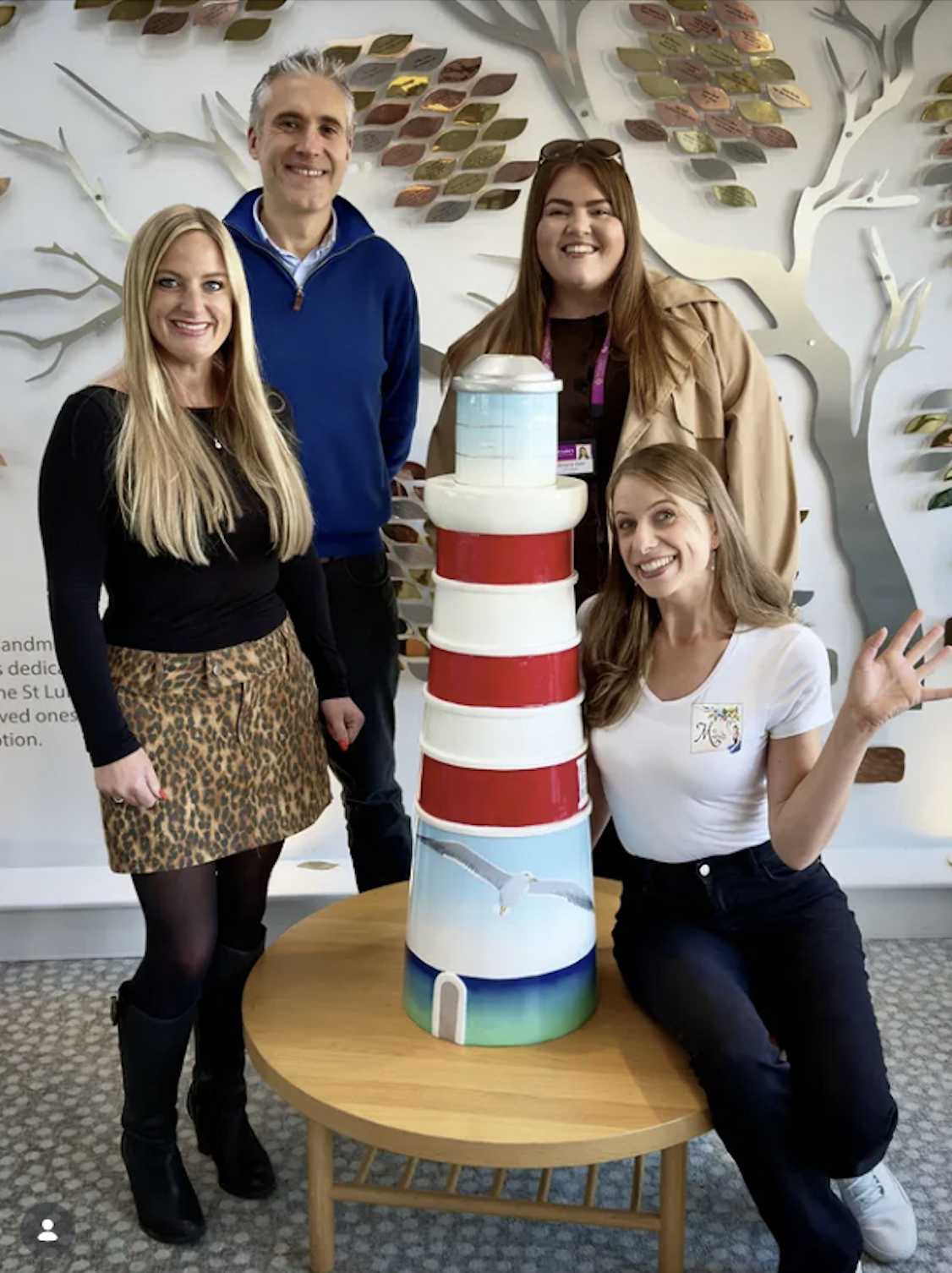
"Mini Murals" lighthouse along with project Co-ordinator Georgina Dyke and lighthouse sponsors GA Solicitors
“They asked me to paint two lighthouses. I've been involved in the project from the very start and I'm really, really grateful that they had me as a launch artist.”
Her support for St Luke’s has extended beyond the sculptures themselves. Last year she painted a large surfboard featuring three Plymouth lighthouses, selling it to raise money for the charity.
Now, after years of anticipation, seeing the finished lighthouse in public has been an emotional experience.
“Now it's finally out there in the public and I'm really, really pleased and so proud to be a part of the project and help raise vital funds and awareness for St. Luke's because they do such an incredible job.”
Her lighthouse stands near the National Marine Aquarium, its design drawing on Plymouth’s extraordinary marine biodiversity.
Seeing people discover the details has been particularly special.
“There's children that are bouncing around it. They're spotting all of my little seahorses that I've painted and all the little fishes and the creatures and the crabs and they're seeing those all around. And then there's full-grown adults that are on the apps and they're taking pictures of it, people taking pictures with it next to it. And it's just so nice to see.”
For her, those seemingly small interactions capture exactly why public art matters.
“I love any kind of public art because it makes it just knowing that I can make a difference in that way and bringing a smile to someone's day is the best part of my job.
“It genuinely is. And seeing people interact and bringing out certain emotions is the best feeling. I'm so lucky to be able to do that.”
It is a philosophy that runs through everything she creates.
“I feel like when you walk into a space, whether it's a different colour, like black or a bright yellow or whatever, a mural can completely change the way you feel about that space that you are in. And if I can create something that's bright and positive and uplifting and brings a smile to someone's face, brings joy to other people, then that is the best part of my job. I couldn't ask for any more.”
More public art for Plymouth
Looking ahead, Mrs Murals would love to see Plymouth continue embracing accessible art in its public spaces.
“I think Plymouth is fantastic in terms of there's lots of different public art that is quite accessible as well, even more so this year with the Guiding Lights project. And any kind of public art project I'm very keen and very excited to be a part of.”
She believes the city is increasingly recognising that public art can offer far more than decoration.
“I think we are growing in that area. I think we're starting to understand the importance of it and understand the impact that that can have both on emotional wellbeing, but also the local economy. I'm just really proud to be a part of any kind of public art project. So yeah, hopefully there's going to be lots more in the future.”
