
Currently unfolding at 37 Looe Street, Metabolizer is an ambitious, quietly radical dance installation by Julia Pond that asks a deceptively simple question: what happens when we treat dance like work, and work like data? Blending solo movement, live participation and economic metaphor, the project invites visitors to step inside a fictional productivity pod and generate dance that is never seen, only tracked, sonified and visualised. Over six weeks, bodies become metrics, time becomes growth, and Plymouth itself is slowly metabolised through collective movement — revealing the strange, exhausting and often absurd systems of value that shape how we live, labour and keep going.
In this conversation, Bracken Jelier speaks with Julia Pond about the ideas, contradictions and lived experiences that sit behind Metabolizer — from dancing as “unproductive” labour and the pressure of constant growth, to Plymouth’s cultural moment and what it means to centre the body in conversations about value. Together, they explore how research, facilitation and performance blur in the work, and why inviting people to dance; invisibly, freely, and on their own terms - might be a powerful way to rethink how we measure what matters.
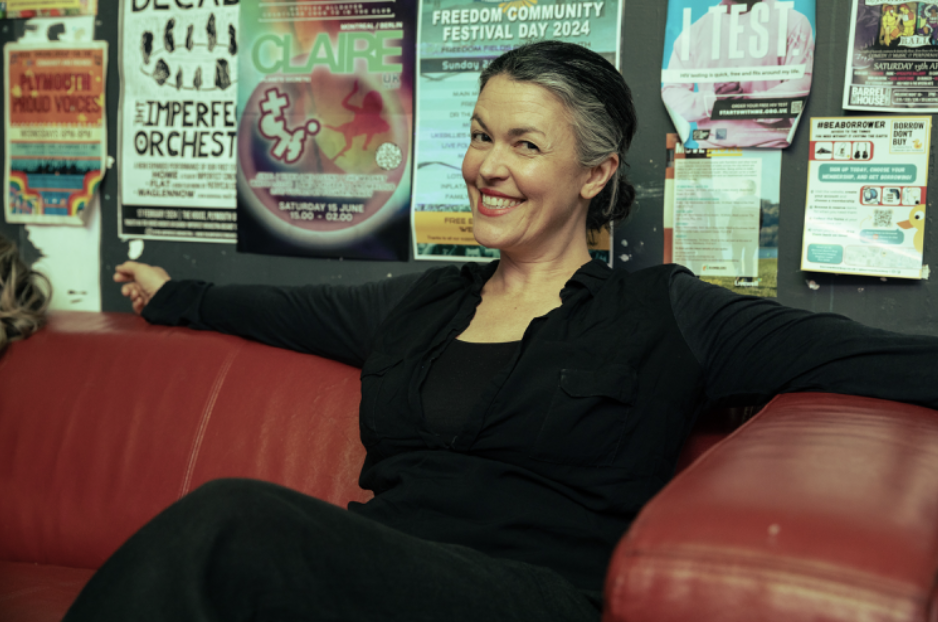
Julia Pond credit Tamas Kovacs
Can you tell us a bit about your practice and the kinds of ideas or questions you’re usually exploring through your work?
My work begins in the moving body - I am a trained dancer and in the first part of my career performed and made more traditional choreographic work. In the last 5 years I have been exploring value, labour and productivity through performance - essentially I like to embody and embed political-economic questions in a humorous and maybe slightly absurd artistic structure. I like to borrow language and tools of corporate culture like power point or the Metabolizer office pod which allow for a playful and absurd way to open up questions about the systems of value and work that organize our society. I’ve also worked a lot with bread dough as a way to consider time and the messiness of the body - my other installation and fictional company BRED was recently commissioned to make a short film for a Science Museum research project that explores issues around industrial patronage of the creative and museum sectors. (I’ll show this on Wednesday 25th Feb as part of Metabolizer’s performance mini-series Optimizer!)
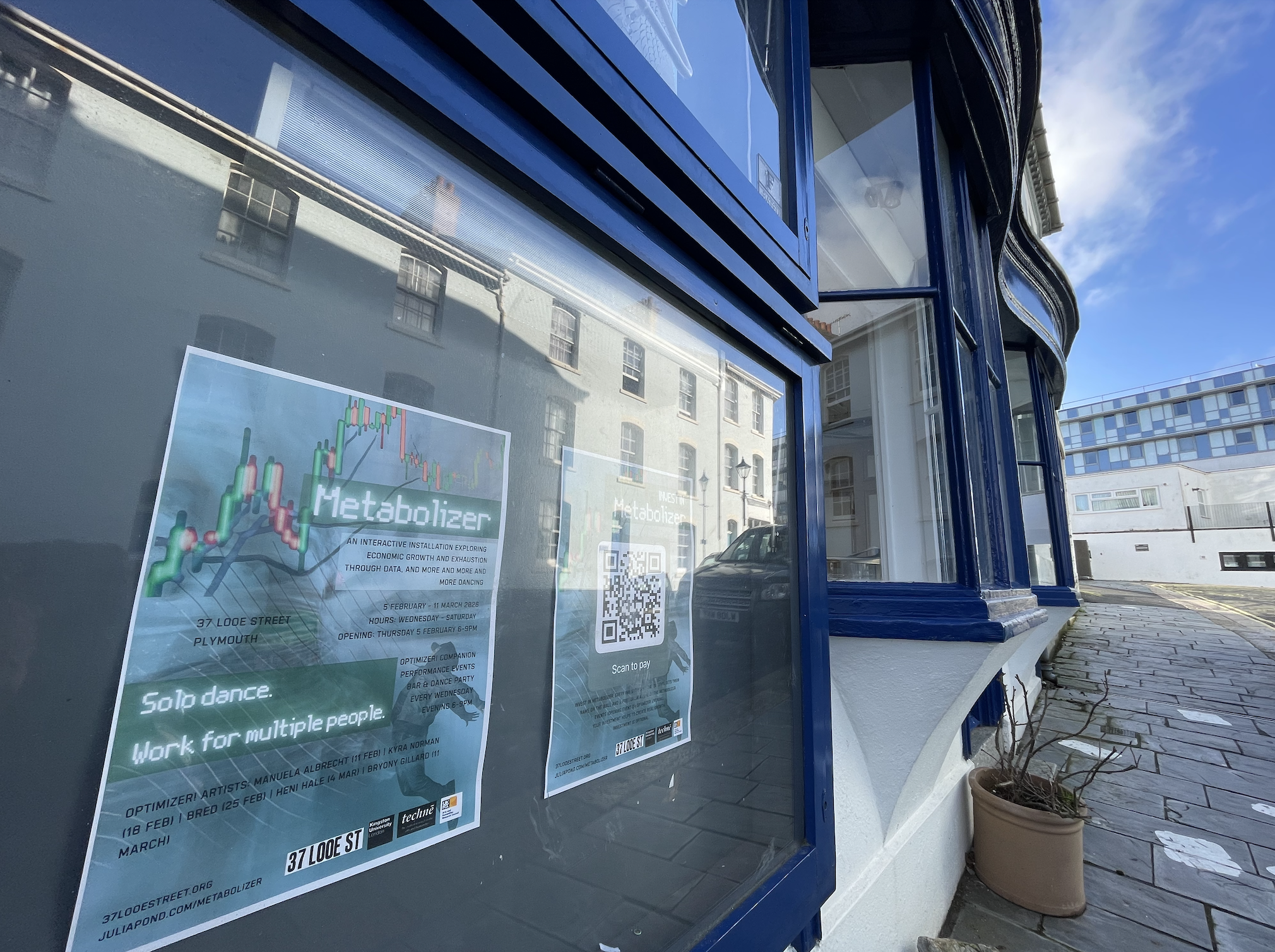
Outside 37 Looe Street - credit Julia Pond
Metabolizer brings together dance, data and ideas about economic growth in a really unusual way. How did this project begin, and what first sparked it for you? Metabolizer grew out of my AHRC / TECHNE supported PhD research at Kingston University; my research is into the notion of “value” and how we might re-articulate it from a body-first perspective, towards an economy that does not deplete people or planet. Recognizing that both economics and dance are about movement - of resources, of bodies - it’s an artistic / poetic contribution to the post-growth economics conversation. It also reflects my inability to focus on one thing, I always seem to need to bring various strands together, to have different projects on the go.
This work asks people to think about growth, labour and exhaustion through their own bodies. Why does dance feel like the right way to explore those ideas?
Dance is generally considered an “unproductive” activity. So spending hours doing it felt like a way to steal back some time. Placing dance in the pod - a space created for productivity - sets up an interesting contrast that hopefully helps to displace expectations about the value of labour. Long periods of dancing offer another ambiguity - they can create total body exhaustion, but also a sense of rejuvenation.
Of course, within the experience of the installation, we don’t actually mention exhaustion - it’s just something that can happen. Contemporary work culture places busy-ness and exhaustion as a badge of honour, while also requiring intensive and often expensive wellness practices to be able to continue to contribute to the economy. Dance is a perfect method to explore these contradictions.
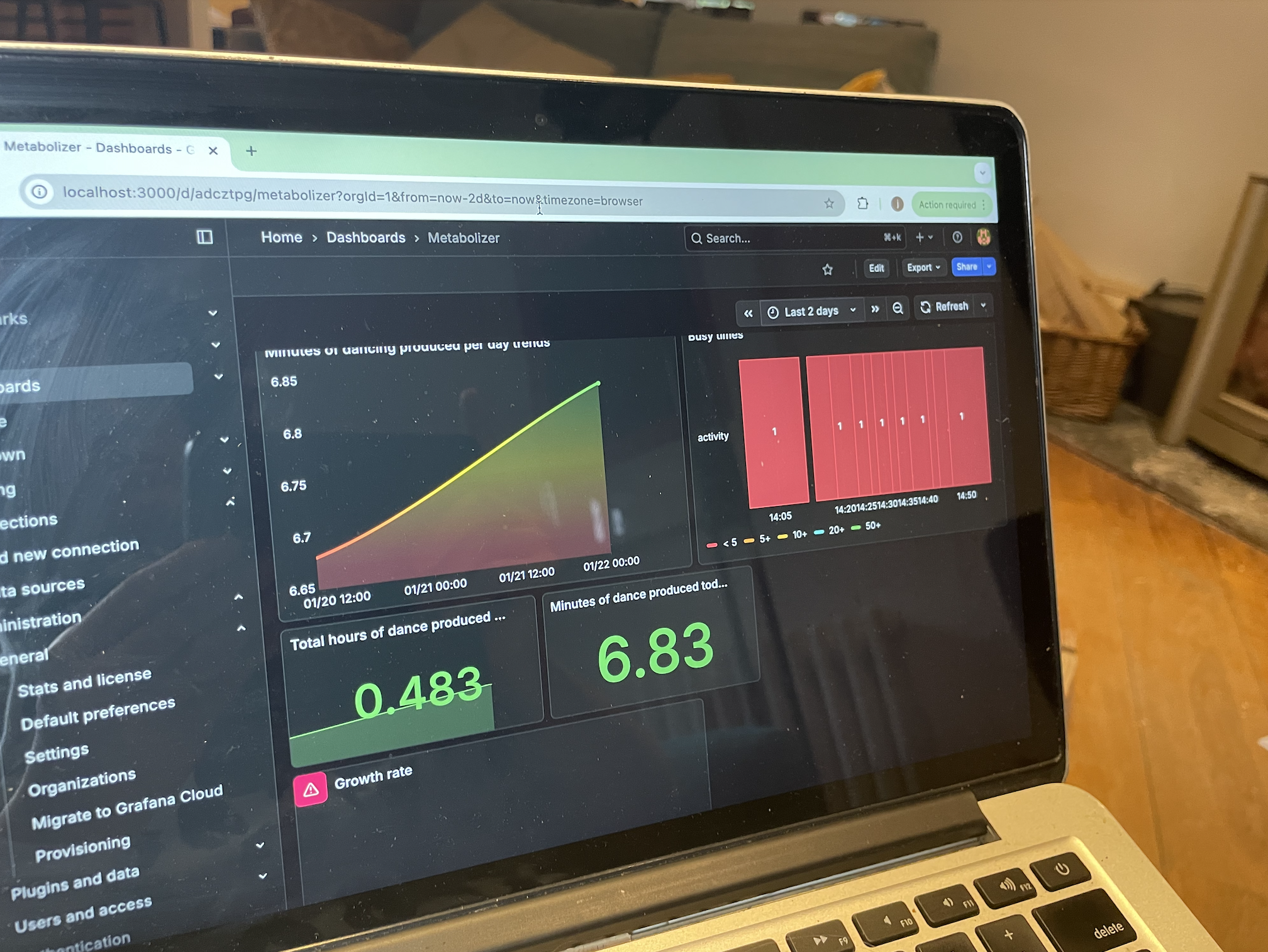
Metaboliser dashboard in progress - credit Julia Pond
For someone who’s never encountered your work before, what happens when they arrive at Metabolizer and step into the space?
I’ll be welcoming folks into the gallery, and chatting about what we’re doing. They can have a look at the data dashboard to see all the stats on rates of dance production and some other fun angles. If they like, they can also read the short essay which shares the thinking behind the installation. If they would like to try out metabolizing - which I hope they will! - they just need to step into the pod, where training and instructions on how to produce dance as well as a selection of playlists and headphones await. The door slides shut and they can then spend as much time as they want metabolizing. They will be able to see the difference they’ve made to the data when they come out.
One of the striking things about Metabolizer is that the dancing is never seen — it becomes anonymous data instead. What was important to you about making that choice?
Disappearing the dancing connects to the labour that disappears in the growth economy - the sweatshop worker, cobalt miner, and reproductive care are all examples of economically under- and un-valued labour. It also reflects the emphasis on evidencing work through quantitative data rather than qualitative outputs, which can be slower and harder to measure, that is a feature of contemporary work culture. So I wanted to mirror this in Metabolizer.
The project aims to increase dance-time by 3% each day, echoing economic growth targets. What are you inviting people to notice or question through that parallel?
The 3% target is annual - and easy to miss the planet-and-people-depleting impacts over the global scale (at least for those of us in the so-called “developed” world). But when the dancing-time needs to grow 3% each day it quickly becomes clear how unsustainable exponential growth is - and this depletion is literalized in one’s body. So over the 5 weeks of the installation we go from 4 hours to 12 hours of dancing. It would then only take us another few weeks - growing by 3% each day, to hit a truly impossible 24 hour a day dance production schedule.

BRED film still - credit Teddy Powell
Alongside the installation, you’re hosting the Optimizer! Wednesday evening events. What do these performances and gatherings add to the overall experience of Metabolizer?
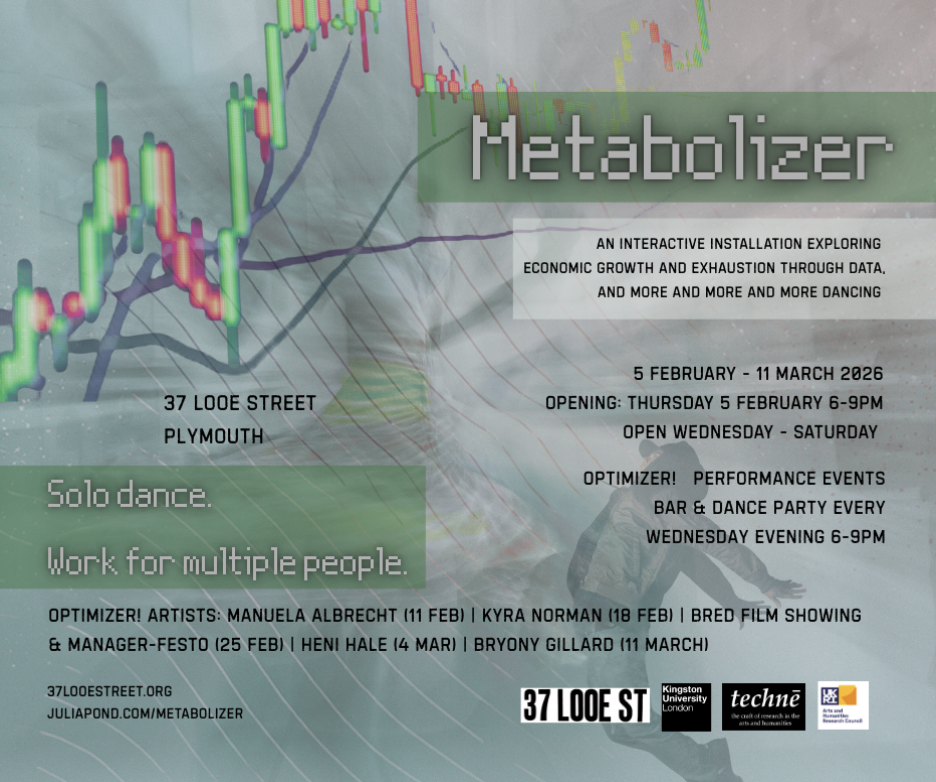
Metabolizer is public and free - and any kind of dancing counts. Inviting other artists to share the space extends this logic of radical inclusion. The artists I’ve invited - Manuela Albrecht, Kyra Norman, Heni Hale and Bryony Gillard – plus an evening with my other project BRED - all bring work that is in dialogue with a facet of Metabolizer. Optimizer! evenings will punctuate the 5 week residency and bring new energy and insight into the space, plus form a chance to get people together to metabolize, raise a glass, experience art and take part in a bit of free-form dancing (we plan to end each evening with a mini-dance party). They’re loosely inspired by the corporate practice of combining social time and improvement like the “lunch and learn.” I hope some folks will come to multiple events and follow along with this thread.
You have a strong connection to Plymouth’s cultural scene. What does it mean to bring this work to the city, and why does Plymouth feel like the right place for it?
Plymouth feels like it’s at such an interesting moment to me, the cultural scene has a friendliness and open-ness that feels open to experimentation and interested in supporting artists. Angela and Sefryn who run 37 Looe Street have been amazingly supportive of the work and this 5 week installation wouldn’t have happened without their willingness to say YES at every turn. Things are feeling expansive, perfect for a project like this that doesn’t fit so neatly into categories. Plus, I think the themes of Metabolizer are for anyone who has experienced the challenges of running to keep up with the cost of living crisis and felt the effects of growing wealth inequality - Plymouth has experienced rising levels of deprivation over the last years and it feels like this project is also connected to that very real experience of depletion. And because I was born not so far from Plymouth, MA, and am now what I call a ‘voluntary migrant’ I feel connected to the story of migration and colonization of North America that started here in Plymouth.
Plymouth has a vibrant dance community, but Metabolizer is open to everyone, with no experience needed. What do you hope both dancers and non-dancers might take from getting involved?
I hope trained dancers get to play with their own sense of performing and being virtuosos and to have a really good time with their dancing being invisible. The pod space is much smaller than a dance studio, so that will be an interesting restriction to work with - what kinds of dancing becomes possible in a smaller space? How does that shift if you keep going for a longer duration? How do you stay interested over the duration? I hope that dancers without formal training also have a really good time and maybe gain some freedom or confidence in their own dancing as well.
Your work often moves between making, research and facilitation. How do those different parts of your practice come together in this project?
The research element of my work both gives rise to these performance structures I make and is a place to reflect on them through writing. In making these structures for relating that bring together objects, instructions, and people, I also have to make the parameters for my own facilitation of the interactive experience – who am I as the host in the space? What is my role and vibe? What kinds of things do I say? It’s a balance between a character and being the very clearest most inviting communicator and host I can be, and having clear boundaries that help everyone relax. There’s also a bit of a tension in being a facilitator / performer - because I have a natural desire to perform - but the nature of doing interactive work means putting this on the back burner in some ways in order to make space for other peoples’ curiosities and needs.
Metabolizer is shaped by both big global questions and very personal experience. How do those two things sit alongside each other in the work?
The work is at heart a personal experience, where the things you actually do are a. Dance and b. Observe data. I’ll also be inviting people to report on the data and experience. So it’s led by one’s own experience of what comes up in their personal embodied experience, and then the invitation is to map that onto the larger issues, a task which the short essay I’ve written does from my own perspective. By centering the personal, I hope to take some of these issues out of what can feel like a very opaque, impenetrable and cerebral space and collectively remember that value and productivity are at heart ways of organizing our moving together.
When people leave Metabolizer — whether they’ve danced, attended an Optimizer! event, or just spent time with the installation — what do you hope stays with them?
I hope they will question their own assumptions about the relationship between qualitative and quantitative value, and the value in their own embodied experience. Plus feel motivated to dance more in their lives.
Finally, if someone is curious but a little unsure whether this is “for them”, what would you say to encourage them to come along?
Just come! You can’t really get it wrong - there’s no pressure to produce any actual dancing - and if you do get in the pod, as you’ll see all kinds of dancing are welcome and we support you with that. The Optimizer! Evenings are a great chance to come to a more traditional performance / talk and get a two for one experience, as you can also try out metabolizing. Ultimately, the work is about things we all experience.
I’ll be here Wednesdays - Saturdays from 10-4 as core hours but opening later and later to get in all the dancing. Everyone is welcome. It’s also totally free. What do you have to lose?
