
Review: A Grain of Sand. Drum Theatre, Plymouth.
By Bracken Jelier
There is something uniquely exposing about a one-person show. With no ensemble to shift the energy, no interval to soften the emotional journey, and nowhere for either performer or audience to retreat, it asks for a different kind of attention. In A Grain of Sand, that intensity is felt from the outset. This is not an easy watch, nor should it be. It is a piece of theatre that asks its audience to stay present with a story shaped by war, loss, memory and survival, and in doing so, demonstrates just how powerful live performance can be.
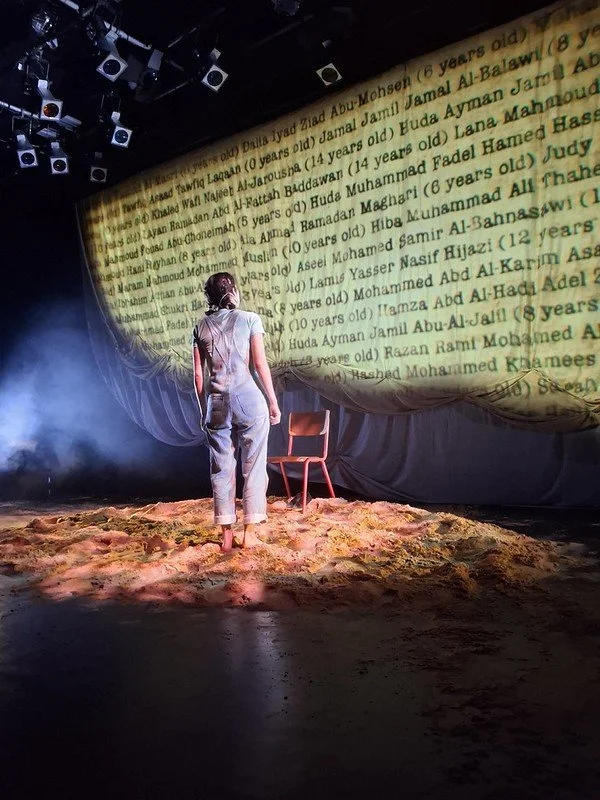
Written and directed by Elias Mattar and performed by Sarah Agha, A Grain of Sand follows Renad, a young Gazan girl searching for her family and for the mythical Palestinian Phoenix, the ‘Anqaa’. Blending folklore with testimony, the production takes on an immense subject through the perspective of a child, allowing imagination and reality to sit side by side. The result is a work that feels intimate rather than overwhelming, human rather than rhetorical.
The staging is striking in its simplicity. A floor covered in sand becomes both landscape and metaphor throughout the performance. It suggests place, but also movement, fragility, memory and transformation. Around this, the use of projection and fabric is subtle yet deeply effective, adding texture and atmosphere without ever pulling focus from the centre of the piece. Every design choice feels measured and purposeful.
At the heart of it all is Sarah Agha’s extraordinary performance. Carrying a production alone for its full duration is no small task, yet she does so with remarkable control, sensitivity and emotional depth. Her performance is physical and expressive, but it is often the smallest details that leave the greatest impact: a glance, a pause, a shift in expression. There is immense feeling in her delivery, and yet it never tips into excess. What emerges is not simply emotion for emotion’s sake, but a carefully crafted performance that honours the story it is telling.
For both writer and director Elias Matar and performer Sarah Agha, this is not material approached from a distance. Matar was born in to a family displaced from Palestine, while Agha also comes from a displaced Palestinian family and is part of a first-generation upbringing shaped by that legacy. That personal and inherited history gives the production an added depth and integrity. It never feels as though this is theatre being used simply to make a point; rather, it feels like a carefully crafted piece of art rooted in lived connection, cultural memory and a genuine sense of responsibility towards the story being told.
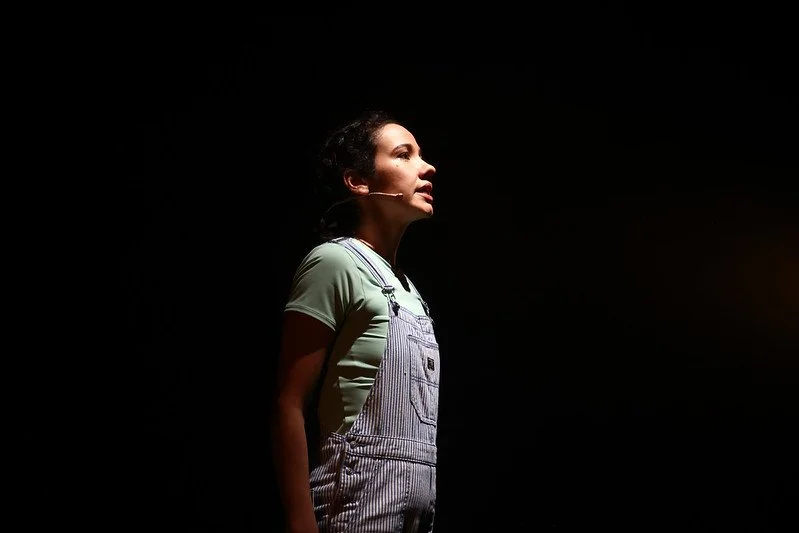
What makes A Grain of Sand so affecting is that it never forgets it is theatre. Faced with material of this weight, it would have been easy for the production to lose its sense of artistry beneath the force of its subject. Instead, it uses the language of performance with great intelligence and care, allowing storytelling to do what it does best: to create space for audiences to feel, reflect and connect. Around the auditorium there were moments of laughter, stillness and audible emotion, particularly during the testimonies drawn from children in Gaza. The response in the room spoke volumes.
This is a production that trusts its audience. It does not simplify its themes, nor does it offer easy comfort. What it offers instead is something much more valuable: a chance to witness a story told with humanity, imagination and conviction. In a cultural landscape where theatre continues to prove its relevance, A Grain of Sand is a reminder of the art form’s ability to hold complexity and turn it into something immediate, moving and unforgettable.
If you have the opportunity to see it, go prepared to listen closely. This is a show that stays with you. https://theatreroyal.com/whats-on/grain-of-sand/
