
In Conversation: Kayla Parker and Stuart Moore on Sea for Yourself’s Mount Batten Project
Artist film-makers Kayla Parker and Stuart Moore are using their Sea for Yourself residency to explore the rich heritage, memory and maritime environment of Mount Batten through moving image, community collaboration and experimental film. In this conversation, they share how the project unfolds across a 360 film with children and local contributors, a developing exhibition programme for the Mount Batten Centre, and King Tide, a new short film poem taking shape during their current residency at GROW.
Ahead of their open studio sessions at GROW on Friday 20 March and Saturday 21 March, they talk with Bracken Jelier about place, process and why Mount Batten continues to inspire their work.
Can you introduce yourself and your practice, and say a little about the kinds of film and moving image work you make?
We’re artist film-makers and are working together on this Sea for Yourself project. We’ve collaborated on many films. We’re experienced film-makers and have created films and produced film projects for Channel 4, BBC and ITV, the Arts Council, the BFI, and the UK Film Council, among others. Our films are screened across the world in exhibitions and at public events such as festivals; we’ve recently shown work at Close-Up cinema in London, Listasafn Árnesinga Art Museum, Iceland, and Strangloscope at the Museu Histórico de Itajaí, Brazil.
Our practice is process-based. This means that our films evolve intuitively through the technical and creative process of making. Our open approach to collaborative film-making means that the end result – the finished film – develops organically and the final form is not imposed from the outset. The on-going conversations that flow between us throughout the production process are an integral part of the process. This dialogic method facilitates the coherent evolution of a film and means we can work independently on elements of a project as part of the collaboration.
There are several strands to the types of collaborative films we make, which draw on our practice as individual film-makers. We make non-fiction works focused on place, including essay films such as ‘Fatherland’, which draws on our experiences of being 'RAF children' whose fathers were stationed in Cyprus during the Cold War. We also make 360 films and short film poems and collaborate with other practitioners including choreographers. Working with film as a material – known as ‘direct animation’ – is a key strand of our practice, evident from our earliest commissions.
We also take on socially engaged work, in which we collaborate with groups and communities – for example ‘There 2 Care’, the animated short film we made with a group of young carers for Plymouth City Council – and the 360 film we’re making now for our Sea for Yourself Mount Batten Project. The socially engaged project work lets us to share our expertise and skills with people who are not professional film-makers and to work with them on developing and realising a short film through a collective process of making.
Last autumn we did a 360 film project with children at Prince Rock school about the environmental rights of rivers, focused on the River Plym at Saltram and Marsh Mills. We worked with the children and their teachers, a law professor and the Barbican Theatre to create a 360 film, ‘What Did the River Say?’, which was screened in the Market Hall dome for the Being Human Festival.
What drew you to Mount Batten as a starting point for this Sea for Yourself residency?
We’ve made films about other waterfront areas of the National Marine Park – Sea for Yourself was the perfect opportunity for a creative film-making residency in a place that we care deeply about. Both of us swim and kayak at Mount Batten; we’re regular visitors here and are familiar with the maritime landscape of the peninsula – particularly the coastal zone experienced from the water as well as on the land.
Sea for Yourself is all about helping people see Plymouth’s relationship with the sea in new ways. How does your residency connect to that wider theme?
The residency as a whole links strongly to the Plymouth Sound National Marine Park aim to encourage people to connect more closely to the sea and to foster greater understanding of our amazing coastal environment.
…Mount Batten… It’s a cliché, but it’s where the magic happens! Today, there’s so much that takes place on the peninsula, work, sports and leisure, but, scratch the surface and the place reveals its history and meaning to people.
It sounds as though this residency has several connected strands. Could you outline the full shape of the project and explain the different elements it includes?
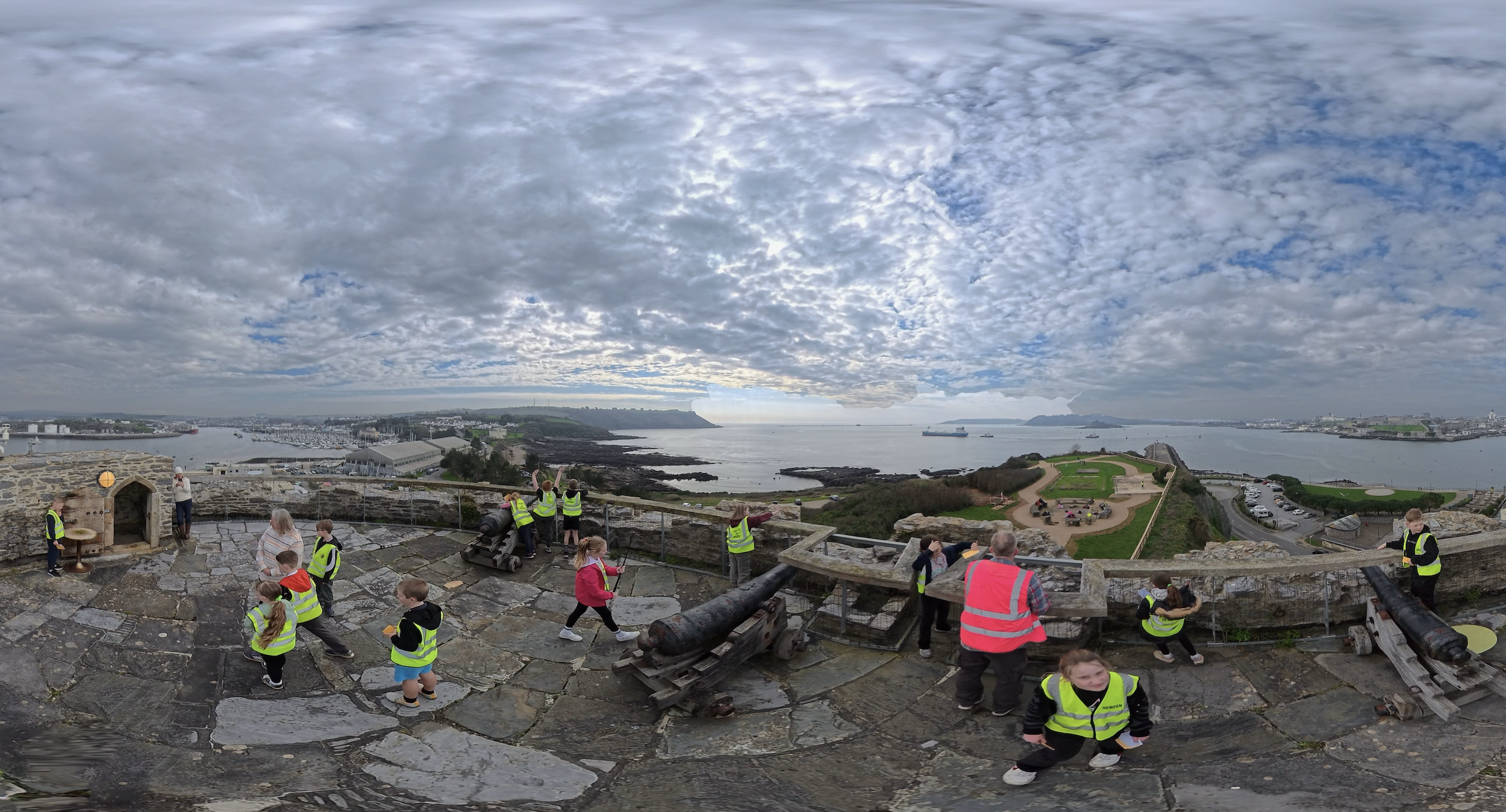
The overall focus of our Sea for Yourself project is Mount Batten, the peninsula or isthmus in the north east corner of Plymouth Sound. It’s a part of Plymouth’s heritage that we feel has been neglected. There are three strands to our project, which interrelate thematically and draw on ideas of place, memory and the heritage of the peninsula, realised through moving image and an exhibition programme.
The principal output for our project is the 360 film we’re making with Year 5 children, aged 9 to 10 years, at Hooe Primary Academy, and people who have strong connections to the Mount Batten peninsula. This film, with real people’s voices at its heart, gives an intergenerational perspective on the histories of the Mount Batten peninsula. The children’s contribution centres on a heritage trail walk from their school, which is next to the Mount Batten, to the Artillery Tower, the most prominent ‘historic’ feature on the peninsula. The film’s audience will hear the poems and see the illustrations the children created after the walk to share their memories of this experience and the ‘histories’ they learned – and what the meaning these have for them. The people from the local community who share their memories of Mount Batten with us form the other important element of the film. Some of these worked on the RAF station during the 20th century when there was no access to the peninsula to the public, others have families who have lived in the area for generations or a strong interest in its histories. The 360 film is supported by the local history group, Old Plymouth Society, which campaigned to save the Artillery Tower from demolition in the early 1960s, and the custodian of the Tower, the Mount Batten Watersports and Activities Centre.
As an additional element of our Sea for Yourself commission, Plymouth Culture invited us to curate and present an exhibition programme for the Mount Batten Centre. This is a wonderful opportunity to provide additional context for people about the peninsula’s heritage when the Centres reopens to the public later this year, following its extensive makeover. In the exhibitions, we expand on some of the historical information we’ve uncovered through archival research and what we’ve learned from working with the children and listening to the local community.
The Sea for Yourself initiative also provides a short artists’ residency at the GROW studios. We’ve used this opportunity as artists to connect with our core theme of place and cultivate a new short film poem, with the working title, ‘King Tide’, that engages with the maritime environment of the Mount Batten peninsula. It’s really important for us to have this protected time dedicated to our own creative practice as artists and film-makers. Our residency takes place from the full moon on the 3rd to the new moon on the 19th of March, when very high and extremely low tides occurred – these are known as ‘king tides’, hence the title!
A King Tide is an exceptionally high tide produced when the gravitational forces of the moon and sun align when the moon is closest in its orbit to the Earth; it creates very high sea levels that conceal what lies beneath… and extremely low water levels that reveal areas of the shoreline that are normally hidden under deep water…
Of those different strands, what would you describe as the main public-facing output in the first phase of the residency?
The 360 film at the amazing Market Hall dome in Devonport will be the main public-facing output. The dome is a unique space that can bring pictures, sound and people together for an immersive experience.
The 360 film is developing through work with children and other local contributors. Can you tell us more about that process and what participants have been exploring?
Hooe school has been brilliant from the start. We’ve really enjoyed working with the children and the staff.
At our first session, we asked the children how they were ‘connected to’ Mount Batten – for most it was through walking their dog, some rode their bikes there and one or two had been to a wedding in the Artillery Tower.
To introduce the children to the histories of their neighbourhood, we devised a heritage trail walk for them from their school at Hooe Lake. Filming with a 360 camera as we walked, we followed the waterfront round past the wharves, winding up through the village of Turnchapel to the Mount Batten Artillery Tower. Along the way, we introduced places of historical note and shared some of the stories about people and events that had happened in these places.
During a follow-up workshop at the school, we ran a poetry-writing and illustration workshop, in which the children composed short poems about their experience of the heritage trail walk and visit to the Artillery Tower, which we recorded for the film. The also drew colourful illustrations that captured their memories of that day, which we will scan for the 360 film.
In parallel to the work with the school for the 360 film, we’ve been talking to people in the local community who have a strong connection to Mount Batten. Filmed interviews will capture these people’s voices for the film, as a complement to those of the children, to produce an intergenerational ‘portrait’ of Mount Batten today.
What have the children and community contributors brought to the project that might not have emerged through archive research alone?
During the project, we’ve shared interesting historical ‘facts’ we’ve uncovered through archival research, along with our own experiences and memories, with our project collaborators, the children and other contributors – they have responded by sharing their memories and lived experience with us, so that real people’s voices are embedded at the heart of the 360 film.
Archive-based research contributes to our understanding of the wider historical context of Mount Batten over many centuries and provides provenance for the narratives that evolve. The focus of our Sea for Yourself project is primarily on the last few centuries and includes the interplay between the militarisation of the peninsula, in times of war and the threat of invasion, and its locus as a place of shipbuilding, farming and leisure.
Alongside the 360 work, you’re also developing a separate moving image piece through your GROW residency. How is that work different, and how does it relate back to the Mount Batten Project as a whole?
Both are centred on place, which has been integral to our creative practice in recent years.
Your GROW residency seems to centre on memory, mark-making and film as a material object. Can you talk a little about that creative methodology?
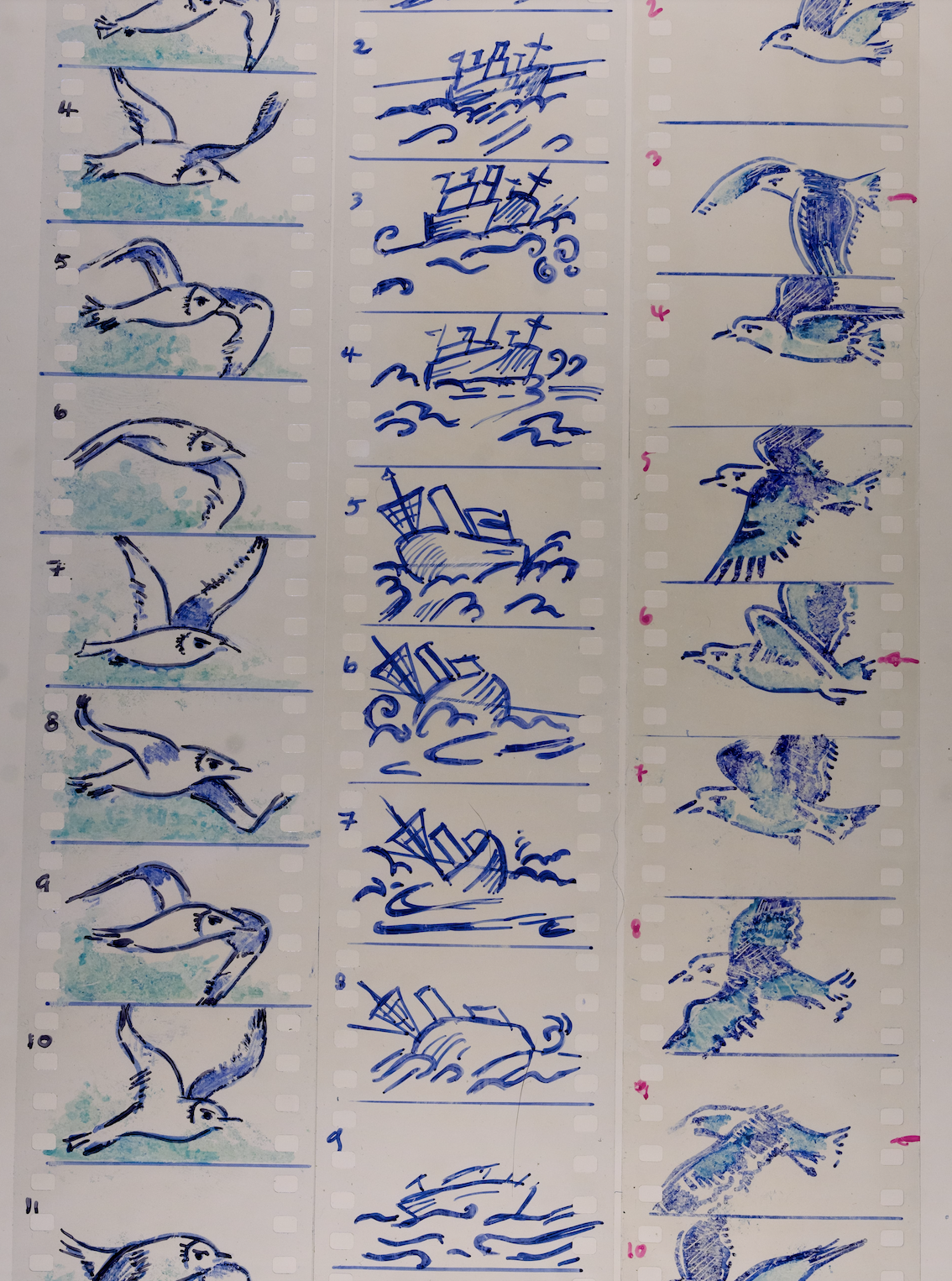
In contrast to the ‘high tech’ aspects of 360 film-making, through the GROW residency, we’re up-cycling old film that’s been discarded and finding a new use for this leftover material that would otherwise go to landfill.
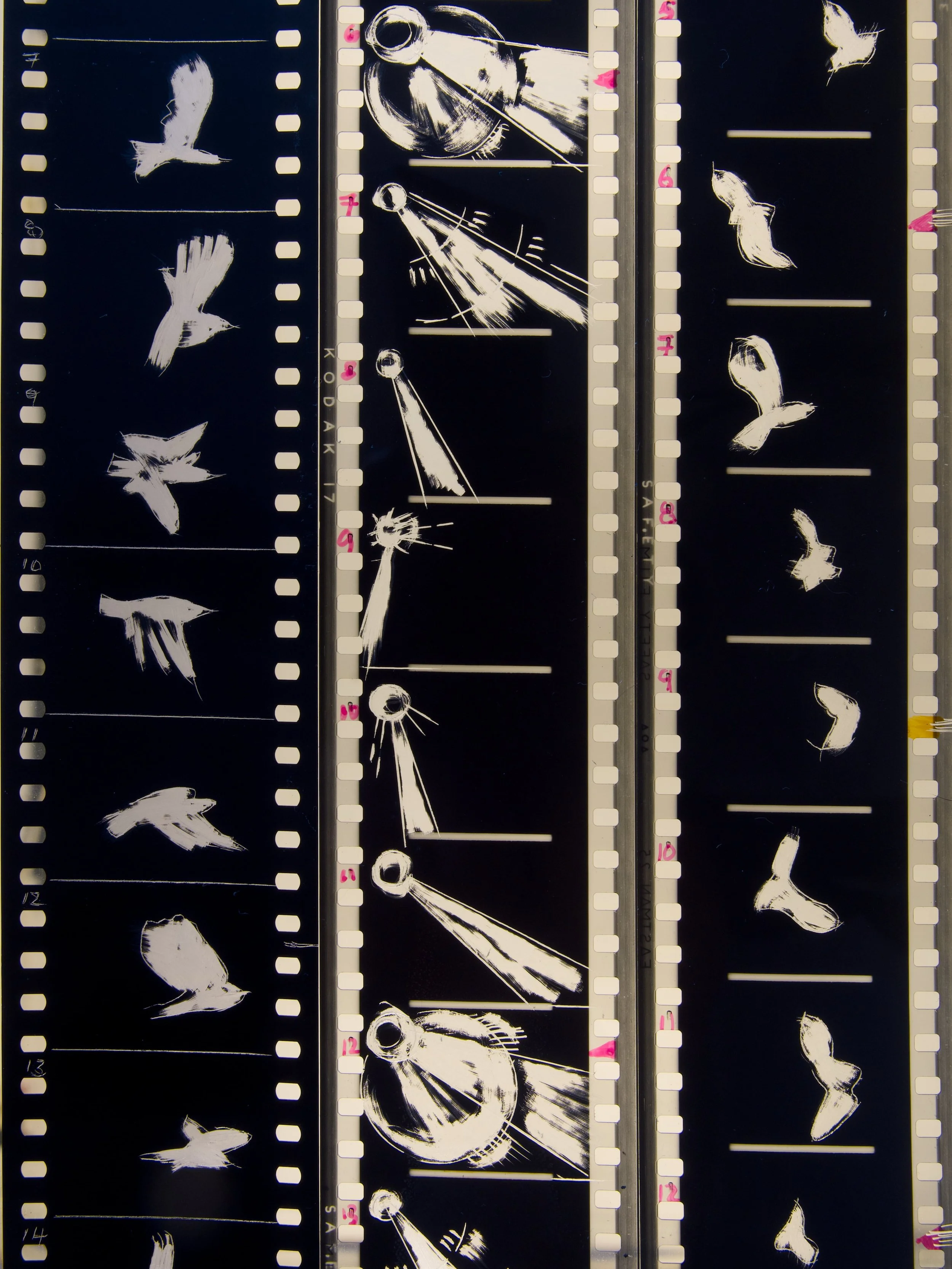
We’ve responded to the opportunity intuitively through creating images ‘physically’ on 35mm film using direct animation techniques such as engraving, printing and drawing. Direct animation is the most physical and intimate form of film-making as the artist touches the film with their hands and interacts with the film itself using mark-making materials and tools. It’s a raw, immediate and impressionistic form of film-making.
Going to the cinema a few years ago, audiences watched feature films, shorts and commercials that were projected from massive, heavy reels of 35mm film. Nowadays, almost all films are made and screened digitally.
Thanks to the GROW residency, in a few short days, we’ve generated a series of experimental sequences of drawings and initial sound compositions for a film poem with a working title of ‘King Tide’.
What might visitors see when they come to the open studio at GROW?
Sea for Yourself open studio sessions at GROW with artist film-makers Kayla Parker and Stuart Moore
Friday 20th March 2026 from 5.00pm to 7.00pm
Saturday 21st March 2026 from 11.00am to 2.00pm
The open studio sessions at GROW are an opportunity for us to share work-in-progress for our Sea for Yourself Mount Batten Project.
Visitors can talk to us about our work with film and sound; we’ll show a taster of the 360 film work we’re making currently with the children at Hooe Primary Academy and the ‘green shoots’ of our short film poem, ‘King Tide’ – all focused on the Mount Batten peninsula, its heritage and maritime environment.
People can see:
a taster of the 360 film, reformatted for single screen;
a compilation of the 35mm sequences for ‘King Tide’, along with examples of examples of our previous, short direct animation film poems ‘Purling’, ‘Cadence’, ‘Flow’, and ‘Flora’;
lightbox display of 35mm artwork for ‘King Tide’;
wall-mounted lightbox of direct animation time-lapse 35mm artwork for ‘Sunset Strip’, the year of sunsets film commissioned by Channel 4 and the Arts Council.
A later part of the residency will unfold through exhibitions at the Mount Batten Centre. What role will those exhibitions play within the wider project?
We’re really excited to be part of the Mount Batten Centre’s new chapter when it reopens to the public after its refurbishment.
We’re looking forward to unpicking the threads of the wider project: local history, nature, memories and hopes for the future through the exhibition programme which we’re developing with the Centre staff. It will be great to share our work on the peninsula right by the South West Coast Path, the locus of our Sea for Yourself residency.
Are there particular stories, objects or themes already beginning to shape those exhibitions?
We’ve uncovered some really interesting material about T.E. Lawrence, who was known as ‘Lawrence of Arabia’. His time an Aircraftman, under the name of Shaw, stationed at RAF Mount Batten was a particularly happy period of his life, when he was able to escape from his celebrity status. He found contentment, and perhaps himself, touched by the magic of the Mount Batten peninsula, in which he felt at home.
The signs are there on a blue plaque and the road names, but we hope to shine a light on this important chapter of his short life through one of the exhibitions.
This residency moves between archive, community participation, landscape and experimental film. What ties all of those elements together for you artistically?
Place – specifically, Mount Batten and the Plymouth section of the South West Coast Path.
What do you hope audiences will take away from the work — whether they encounter it through the 360 film, the exhibitions, or the GROW residency?
We see it as bridge-building between generations and between Mount Batten, the rest of Plymouth, and beyond.
What are the next key moments in the project that people should look out for?
The 360 film – which doesn’t have a definitive title yet – will be shown at the Market Hall dome in June at a special screening for the children at Hooe school and contributors. After this, we hope that a wider audience will have the opportunity to see the film at public screenings.
People can also see our 35mm short film poem ‘King Tide’ when it’s completed in the summer.
The start of our Sea for Yourself exhibition programme will coincide with the opening of the Mount Batten Centre, expected to be in early autumn.
Kayla and Stuart’s residency is part of Sea for Yourself, a programme led by Plymouth Culture in partnership with Plymouth Sound National Marine Park and Plymouth City Council. The programme development and delivery is supported by The Box, Real Ideas, Arts University Plymouth, University of Plymouth and Theatre Royal Plymouth. Sea for Yourself is funded by The National Lottery Heritage Fund, Arts Council England Place Partnership Fund and Plymouth City Council. The residency is being generously supported by Grow Studios and Real Ideas.
